Prescription required. We facilitate access to medicines already prescribed by your treating physician. We do not provide medical advice or diagnoses.


Clinical Guide to the BRAF Mutation and Targeted Therapy

Understanding your pathology report and genetic testing is the first step in precision oncology. If your tumor tissue has tested positive for a BRAF mutation, your medical team has identified the specific genetic driver responsible for your cancer’s growth. This finding directly dictates your targeted treatment options.
The Biology of the BRAF Gene
The BRAF gene provides instructions for producing the BRAF protein, a critical signaling enzyme inside your cells. Its primary function is to regulate cell growth and division.
Normally, the BRAF protein is inactive. It only turns on when the body requires new cells (e.g., for tissue repair), sending a brief, controlled signal to divide before turning back off.
The MAPK/ERK Signaling Pathway
To understand the mutation, you must understand the cellular communication route it disrupts, known as the MAPK/ERK pathway.
- Upstream Trigger (RAS): The RAS protein receives a growth signal from outside the cell and activates BRAF.
- The Catalyst (BRAF): BRAF activates the next protein in the chain, MEK.
- Downstream Effectors (MEK & ERK): MEK activates ERK, which enters the cell nucleus and delivers the command to copy DNA and divide.
The BRAF Mutation
When a mutation occurs in the BRAF gene, the DNA sequence is altered, causing the cell to produce a physically deformed BRAF protein. This deformed protein is locked in a permanently “active” state. It continuously signals MEK and ERK to divide, entirely ignoring the upstream RAS protein and the body’s natural regulatory systems. This uncontrolled multiplication results in tumor formation.
The V600E Hotspot
Approximately 90% of all BRAF mutations occur at a specific location on the protein known as position 600.
- The Genetic Change: In a healthy cell, position 600 contains the amino acid Valine (V). A genetic error swaps Valine for Glutamic acid (E).
- The Result: This is the BRAF V600E mutation. The introduction of Glutamic acid alters the protein’s electrical charge and 3D structure, causing the permanent activation of the MAPK pathway.
- Note: Other variants, such as V600K (Valine replaced by Lysine), occur less frequently but are typically treated with the same targeted therapies.
Associated Cancer Types
BRAF mutations are actionable biomarkers found across several distinct malignancies:
- Melanoma: Found in ~50% of advanced cutaneous melanomas.
- Colorectal Cancer: Found in 8% to 10% of cases.
- Papillary Thyroid Carcinoma: Found in 40% to 50% of cases.
- Non-Small Cell Lung Cancer (NSCLC): Found in 1% to 2% of lung adenocarcinomas.
Mechanism of Action: Targeted Inhibitors

Historically, BRAF-driven cancers were treated with broad-spectrum chemotherapy. Today, the standard of care relies on BRAF Inhibitors (e.g., vemurafenib, dabrafenib, encorafenib).
These are oral, small-molecule tyrosine kinase inhibitors engineered to shut down the defective BRAF protein.
- Competitive Inhibition: The mutated BRAF protein uses cellular energy (ATP) to fire its signals. The inhibitor drug is designed to physically bind to the microscopic V600E pocket on the protein, blocking ATP from entering.
- Pathway Shutdown: Without ATP, the BRAF protein stalls. It stops signaling MEK and ERK. Deprived of the growth signal, the cancer cell ceases division and undergoes apoptosis (programmed cell death).
- Target Specificity: These drugs specifically target the mutated V600 protein, largely sparing healthy cells that rely on normal BRAF. This minimizes the severe systemic toxicities associated with traditional chemotherapy.
Clinical Efficacy and Combination Therapy
Cancer cells are highly adaptive and can develop Acquired Drug Resistance to a single BRAF inhibitor (often by reactivating MEK downstream or mutating the upstream RAS protein).
To prevent resistance and improve outcomes, oncologists use Combination Therapy.
- Melanoma & NSCLC: Standard treatment combines a BRAF inhibitor with a MEK inhibitor (e.g., trametinib, cobimetinib). This dual blockade of the MAPK pathway significantly increases the Objective Response Rate (ORR), extends Progression-Free Survival (PFS), and mitigates paradoxical skin side effects.
- Colorectal Cancer: Colon tissue has alternate biological pathways. Standard treatment pairs a BRAF inhibitor with an EGFR inhibitor (e.g., cetuximab) to successfully block tumor growth.
Interpreting Clinical Trial Data
When reviewing medical literature or discussing prognosis with your oncologist, you will encounter specific visual data mapping.
The Kaplan-Meier Survival Curve
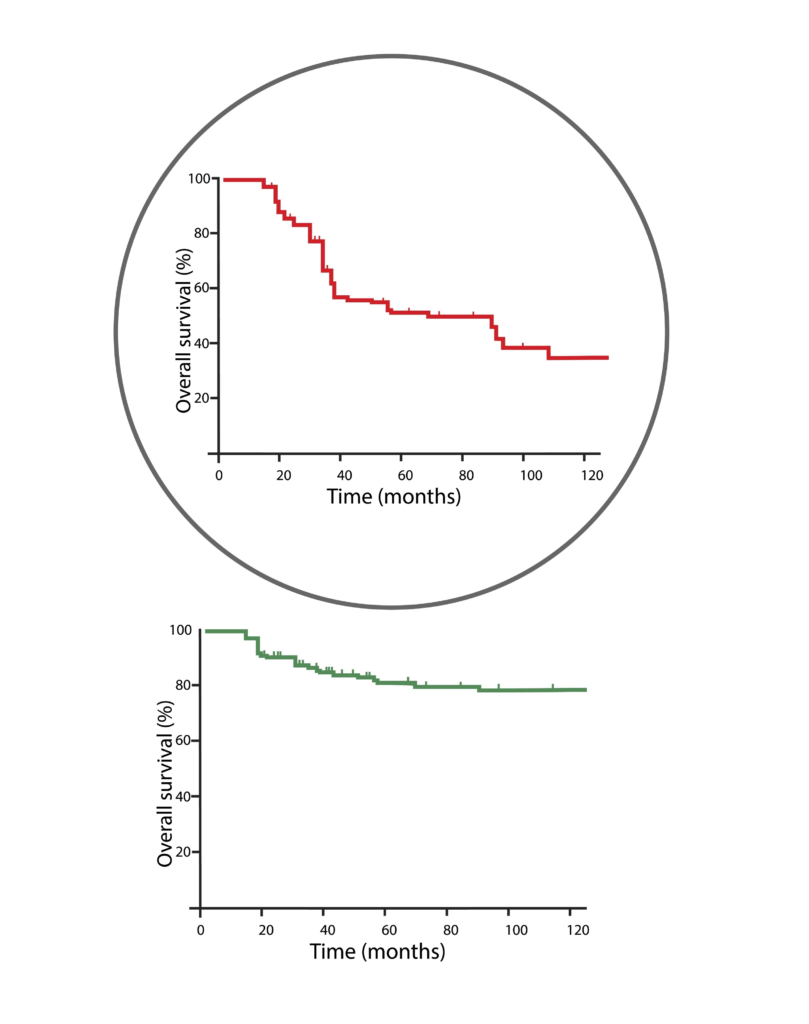
This graph tracks the percentage of patients whose disease remains controlled over time.
- X-Axis (Horizontal): Time (months/years) since starting treatment.
- Y-Axis (Vertical): Percentage of patients whose tumors have not progressed.
- Interpretation: A line that remains high and stretches far to the right before stepping down visually represents extended months or years of stable, controlled disease.
The Waterfall Plot
This graph visually demonstrates tumor shrinkage across a patient group.
- Center Line (0%): Represents the tumor’s baseline size before treatment.
- Vertical Bars: Each bar represents an individual patient’s response.
- Interpretation: Bars dropping below the 0% line indicate a reduction in tumor volume. A successful trial will look like a “waterfall,” with the vast majority of bars pointing deeply into negative percentages.
Educational Resources
For primary source data, detailed clinical guidelines, and verification of targeted therapy protocols, consult the following peer-reviewed medical institutions:
- American Society of Clinical Oncology (ASCO): Clinical practice guidelines for molecular testing and targeted therapy.
- National Cancer Institute (NCI): Comprehensive data on the MAPK signaling pathway and active clinical trial directories.
- The Cancer Genome Atlas (TCGA): Foundational genomic mapping of the BRAF V600E mutation across solid tumors.
- National Center for Biotechnology Information (NCBI) / PubMed: Database of peer-reviewed journals detailing mechanisms of acquired resistance and milestone trial outcomes (e.g., COMBI, BEACON).
Disclaimer: The information provided in this article is for educational and informational purposes only. It is not a substitute for professional medical advice, diagnosis, or treatment. Always consult with your oncologist or healthcare provider regarding your specific medical condition, genetic testing results, and customized treatment plan. Medically Reviewed by: Salma Elreedy, Clinical Oncology, Sphinx Cure Oncology Center
[…] Read more: BRAF mutation and targeted cancer therapy […]