Prescription required. We facilitate access to medicines already prescribed by your treating physician. We do not provide medical advice or diagnoses.


Fulvestrant Injection: How It Works, Dosing, and What to Expect

Medically Reviewed by: Dr. Salma Mamdouh Elreedy, Clinical Oncologist, Sphinx Cure Oncology Center Fact-Checked by: Generic Oncology Editorial Team Reviewed: July 2026
Hearing a new drug name for the first time is disorienting, especially when it comes wrapped up in an already overwhelming diagnosis. If your oncologist has just mentioned fulvestrant, you probably have a dozen questions running through your head at once. How does it actually work? Why is it an injection instead of a pill? What happens at the appointment, and what happens afterward?
This guide walks through all of that in plain language. We’ll cover the biology behind fulvestrant, the standard dosing schedule, what the injection itself involves, and what most patients experience in the days that follow. Wherever it matters, we’ve also included simple visuals to make the process easier to picture.
A quick note before we start: this article is written for general education. It isn’t a substitute for advice from your own oncology team, who know your specific case far better than any article can.
1. What Is Fulvestrant?
Fulvestrant is a hormone therapy used to treat a specific kind of breast cancer: hormone receptor-positive (HR-positive), HER2-negative breast cancer. In practice, this means the cancer cells rely on estrogen to grow, and testing has shown they don’t overexpress the HER2 protein.
It’s most often prescribed for postmenopausal women whose breast cancer is advanced or has spread beyond the breast. Some patients receive it as their very first hormone therapy. Others receive it after the cancer has stopped responding to a different hormonal treatment, such as tamoxifen or an aromatase inhibitor.
Pharmacologically, fulvestrant belongs to a drug class called selective estrogen receptor degraders, or SERDs for short. That name sounds technical, but the idea behind it is fairly intuitive once you see how the drug behaves in the body — which is exactly what the next section walks through.
Fulvestrant isn’t new. It was first approved in 2002, and it has been studied and refined for over two decades. That long track record is part of why oncologists reach for it so often: there’s a large body of clinical evidence behind how it performs, and how patients tend to tolerate it.
2. How Does Fulvestrant Work?
To understand fulvestrant, it helps to understand what estrogen normally does inside an HR-positive cancer cell. Some breast cancer cells carry proteins called estrogen receptors, almost like docking ports on the surface of the cell. When estrogen docks onto one of these receptors, it sends a signal telling the cell to grow and divide. Left unchecked, this is exactly how the tumor keeps expanding.
Fulvestrant interrupts that signal in two distinct ways, which is part of what sets it apart from older hormone therapies like tamoxifen.
First, it blocks the receptor. Fulvestrant physically attaches to the estrogen receptor itself. Once it’s bound there, estrogen simply can’t dock anymore. The growth signal that would normally follow never gets sent.
Second, it breaks the receptor down. This is the “degrader” part of the SERD name, and it’s the feature that makes fulvestrant unique. Rather than just sitting on the receptor and blocking it, fulvestrant triggers the cell to destroy the receptor entirely. Over time, the number of receptors available on the cell’s surface drops. Fewer receptors means less opportunity for any remaining estrogen to send a growth signal, even indirectly.
The diagram below shows this shift side by side.
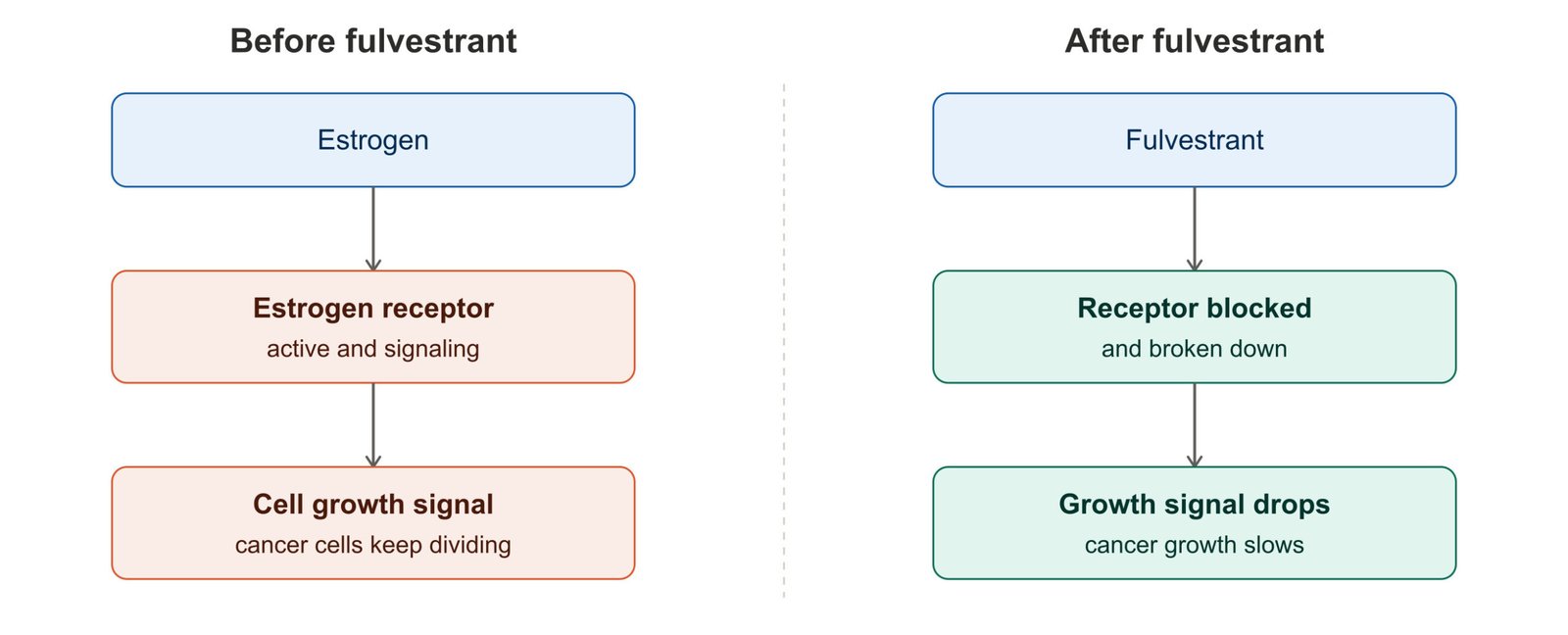
The combined effect — blocking existing receptors while gradually reducing their numbers — is why fulvestrant can still work in some cancers that have grown resistant to other hormone therapies. Tamoxifen works a little differently: it blocks the receptor but doesn’t break it down the same way. Resistance to hormone therapy is a complex, multi-factor process, but this mechanistic difference is thought to be part of why fulvestrant sometimes remains effective when other options have stopped working.
3. Fulvestrant in Combination Treatment
Fulvestrant is often prescribed on its own, but in many cases today, it’s paired with a second targeted drug. This isn’t a minor detail — it’s become a standard part of how advanced HR-positive breast cancer is treated, so it’s worth understanding even in a patient-facing overview.
The most common pairing is with a class of drugs called CDK4/6 inhibitors. These work through a completely different mechanism, targeting proteins involved in cell division rather than estrogen signaling directly. When combined with fulvestrant, they attack the cancer from two angles at once. The three CDK4/6 inhibitors most often used alongside fulvestrant are:
- Palbociclib (brand name Ibrance)
- Abemaciclib (brand name Verzenio)
- Ribociclib (brand name Kisqali)
More recently, a third combination has become available for a specific patient group: inavolisib (brand name Itovebi) given together with both palbociclib and fulvestrant, as a three-drug regimen. This triplet is approved specifically for patients whose tumors carry a genetic change known as a PIK3CA mutation. Your oncology team may test your tumor tissue for this mutation before deciding on a treatment plan, since it directly affects which combination is likely to work best.
None of this changes how the fulvestrant injection itself is given. If you’re on a combination regimen, you’ll typically still receive fulvestrant on the same schedule described below, while taking the second medication as an oral pill on its own dosing pattern. Your care team will walk you through exactly how the two fit together.
4. Fulvestrant Dose and Treatment Schedule
The standard adult dose is 500 mg, delivered as two separate 5 mL injections — one into each side of the buttock. Splitting the dose this way keeps each individual injection smaller and more comfortable than a single large one would be.
The schedule follows a specific rhythm, and it’s one of the more distinctive things about fulvestrant compared to other hormone therapies. You’ll receive it more frequently at the start of treatment, then settle into a monthly rhythm once your body has reached a steady level of the drug.
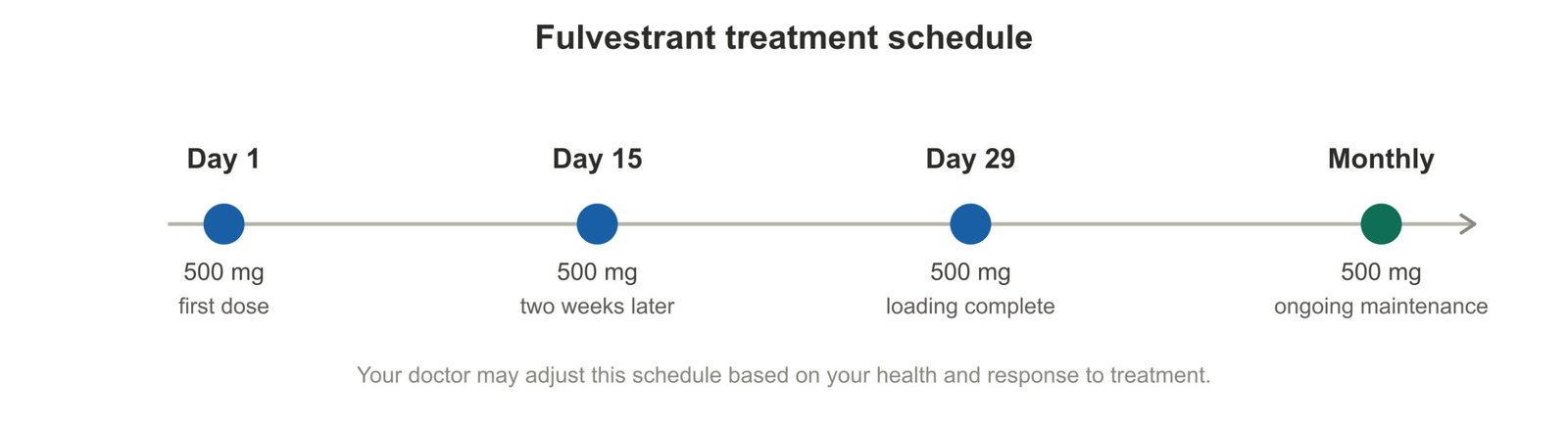
| Visit | Dose |
|---|---|
| Day 1 | 500 mg |
| Day 15 | 500 mg |
| Day 29 | 500 mg |
| Every month after | 500 mg |
The first three doses arrive two weeks apart. This “loading” period helps the drug build up to an effective level in the body more quickly. After day 29, you shift to a single dose every month for as long as the treatment continues to help.
One detail worth knowing: liver function affects dosing. If you have moderate hepatic impairment, your doctor may prescribe a reduced 250 mg dose instead of the standard 500 mg, since the liver plays a role in how the body processes fulvestrant. This is exactly the kind of adjustment your oncology team will handle based on your bloodwork, so it’s nothing you need to calculate yourself — just something to be aware of if your doctor brings it up.
Your care team may also adjust your overall schedule depending on how you respond, what other medications you’re taking, and your broader health history.
5. How Is the Injection Given?
One point worth stating clearly: fulvestrant is not designed to be self-injected at home. Unlike some other treatments patients learn to administer themselves, this one is given exclusively by a trained healthcare provider, in a clinical setting.
Here’s roughly what a typical appointment looks like:
- Your nurse or doctor prepares the prefilled syringes and checks them before administration.
- You’ll either lie on your side or stand, depending on how your clinic prefers to give the injection.
- The medication is injected slowly and deliberately, rather than as a quick jab.
- You may be asked to wait for a short period afterward so your care team can monitor how you’re doing.
The slow, deliberate pace isn’t incidental. Fulvestrant is a relatively thick, oil-based solution, and injecting it gradually is part of standard technique to help reduce discomfort at the site. Your nurse or doctor can walk you through exactly what to expect at your specific clinic.
6. Where Is Fulvestrant Injected?
Fulvestrant is injected into the gluteal muscle, which is the large muscle in the buttock. Because the full dose is split into two 5 mL injections, you’ll receive one shot on each side during a single visit rather than one larger injection in one spot.
There’s a practical reason for this two-injection approach beyond comfort. A large muscle like the gluteal muscle absorbs medication more evenly when the volume is divided, which supports more predictable drug levels in your blood over the following weeks.
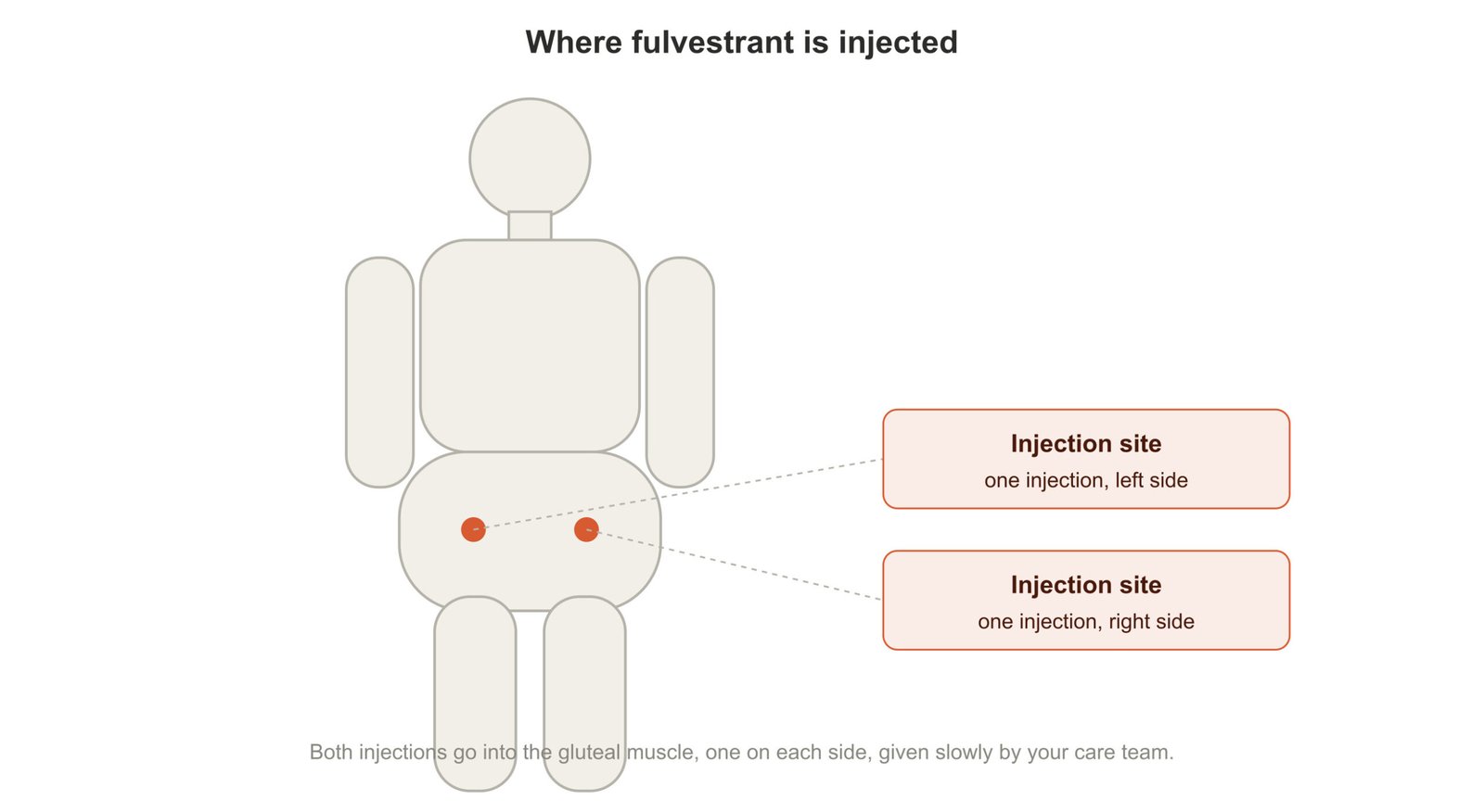
Precise placement matters here. The gluteal area sits close to the sciatic nerve, and the prescribing information specifically notes that care is needed to avoid this nerve during injection. This is one of the reasons fulvestrant is given only by a trained healthcare provider rather than self-administered — correct technique and site selection are part of what makes the injection safe.
7. What to Expect After the Injection
Some soreness after a fulvestrant injection is common, and for most patients, it’s manageable and short-lived.
At the injection site itself, you might notice:
- Pain or tenderness that can last a day or two
- Mild redness
- Slight swelling around the area
More generally, some patients report:
- Hot flashes
- Fatigue
- Joint or muscle aches
- Nausea
- Headaches
Most of these effects are mild-to-moderate and tend to ease as your body adjusts to treatment. That said, a few things are worth knowing beyond the common list, because they’re part of what your care team will actively monitor.
Liver enzyme changes are fairly common with fulvestrant, showing up in more than 15% of patients in clinical trials. This usually doesn’t cause any symptoms you’d notice on your own, which is exactly why your doctor will order periodic blood tests during treatment — to catch any changes early, well before they’d become something you’d feel.
Bleeding risk is also worth flagging. Because fulvestrant is injected into muscle, anything that affects your body’s ability to clot — blood thinners, a bleeding disorder, or a low platelet count — can increase the chance of bruising or bleeding at the injection site itself. This doesn’t rule out treatment; it just means your care team will want the full picture. Make sure your oncologist has your complete medication list and health history before your first dose, so they can watch the injection site more closely if needed.
Contact your care team promptly if you notice:
- Injection-site pain that is severe or getting worse rather than better
- Signs of infection, such as increasing warmth, redness, or discharge at the site
- Unusual bruising or bleeding
- Any new symptom that feels significant or out of the ordinary
None of this is meant to alarm you — most patients tolerate fulvestrant reasonably well. It’s simply useful to know what falls into the “call your doctor” category versus what’s a normal, expected part of treatment.
8. Preparing for Your Appointment
A little preparation can make injection days easier, both physically and mentally.
Before your appointment:
- Wear loose, comfortable clothing that gives easy access to the injection area.
- Let your care team know about any past reactions to injections, even minor ones.
- Write down any questions about your schedule so you don’t forget them in the moment.
After your appointment:
- Follow whatever specific aftercare advice your nurse gives you.
- Keep an eye on the injection site over the next day or two.
- Reach out to your care team if anything feels off rather than waiting it out.
Many patients find that the first appointment feels like the biggest unknown, and that later visits feel far more routine once they know what to expect.
9. Brand-Name Faslodex vs. Generic Fulvestrant: Cost and Access
Fulvestrant is sold under the brand name Faslodex®, which is FDA-approved in the United States. But brand-name pricing puts it out of reach for a large number of patients worldwide, particularly in countries where it isn’t covered by insurance or a national health system.
Generic fulvestrant is manufactured by pharmaceutical companies around the world, including under WHO-GMP certified manufacturing standards. It’s worth being clear about what that certification does and doesn’t mean: WHO-GMP certifies the manufacturing quality and process, but it is not the same as FDA approval, which is a separate, country-specific regulatory status. Whether a particular generic version carries FDA approval depends entirely on the manufacturer and the country in which it’s registered.
This is where Named Patient Programs (NPPs) come in. An NPP is a legal framework that allows a patient to import and access a specific medication for their own treatment, even when that exact product isn’t registered or available in their home country. It’s commonly used when a needed medication is delayed, unavailable locally, or priced well beyond what a patient can afford.
10. Frequently Asked Questions
How does fulvestrant work?
It blocks estrogen receptors on cancer cells and gradually reduces how many receptors are available in the first place. Together, these two actions slow down or stop estrogen-driven cancer growth.
What is the standard fulvestrant dose?
The standard dose is 500 mg, given as two injections on days 1, 15, and 29. After that, one dose is given every month.
Where is fulvestrant injected?
It’s injected into the gluteal muscle, with one shot given on each side during a single visit.
Is fulvestrant a form of chemotherapy?
No. Fulvestrant is a hormone therapy. It works by targeting estrogen signaling rather than directly killing rapidly dividing cells the way traditional chemotherapy does.
Can fulvestrant be combined with other medications?
Yes. It’s frequently combined with a CDK4/6 inhibitor such as palbociclib, abemaciclib, or ribociclib. For PIK3CA-mutated cancers, it may also be given as part of a three-drug regimen with inavolisib and palbociclib together. Your oncologist will determine whether a combination approach fits your specific diagnosis.
Can I give myself the fulvestrant injection at home?
No. A trained healthcare provider needs to give this injection, since it requires specific technique and follow-up monitoring that isn’t suited to home administration.
How long does fulvestrant treatment usually continue?
There’s no fixed endpoint. Most patients continue treatment for as long as it’s controlling the cancer effectively and side effects remain manageable, with your oncologist reassessing periodically through scans and bloodwork.
Is generic fulvestrant as effective as Faslodex?
Generic fulvestrant contains the same active ingredient as the brand-name version. Manufacturing standards and regulatory approval can still vary between manufacturers and countries, so it’s worth confirming sourcing and certification details before starting treatment.
11. References
- Fulvestrant Injection — FDA prescribing information, DailyMed
- Faslodex (fulvestrant) for Breast Cancer — breastcancer.org
- Fulvestrant (Faslodex) — Macmillan Cancer Support
- FDA approves inavolisib with palbociclib and fulvestrant — Oncology Nursing Society
[PLACEHOLDER: confirm these are the current label/page versions at time of publishing, and add an NCI or NCCN patient-guideline link if your reviewer prefers a fourth independent source.]
The content and clinical information on this page are provided for educational purposes only. They do not replace personalized medical advice from your oncology team. Always consult your doctor before starting, stopping, or adjusting any cancer treatment. This article is not sponsored content; the access information below is provided separately by Generic Oncology.
Need help accessing fulvestrant?
Generic Oncology sources WHO-GMP certified fulvestrant and helps patients navigate access through Named Patient Program (NPP) frameworks when the brand-name product is unavailable or unaffordable where they live.
- Upload your prescription to check availability and pricing for your situation.
- WhatsApp: +8801792288474
- Email: [email protected]
This section is provided by Generic Oncology and is separate from the medical information above. It is not a treatment recommendation.