Prescription required. We facilitate access to medicines already prescribed by your treating physician. We do not provide medical advice or diagnoses.


Multiple Myeloma Treatment: Drugs, Regimens and How They Are Sequenced

Written by Salma Abdel. Medically reviewed by Dr. Salma Mamdouh Elreedy, Clinical Oncologist, Sphinx Cure Oncology Center. Last reviewed: [September 2026]
Multiple myeloma treatment combines drugs from different classes, usually three or four at a time, and is given in phases: induction, often a stem cell transplant, then long-term maintenance. The backbone for most patients is a proteasome inhibitor (bortezomib or carfilzomib), an immunomodulatory drug (lenalidomide, pomalidomide or thalidomide) and dexamethasone. Current US and European guidelines add an anti-CD38 antibody to this backbone at diagnosis where it is available.
Key facts
- Myeloma is treated in lines. Each relapse leads to a new combination built from drug classes the patient has not yet become resistant to.
- Current guidelines prefer four-drug (quadruplet) regimens at diagnosis, based on an anti-CD38 antibody plus bortezomib, lenalidomide and dexamethasone.
- Lenalidomide is the standard maintenance drug after stem cell transplant.
- Where anti-CD38 antibodies are not available, three-drug regimens such as VRd, KRd and VTd remain the core of treatment.
What is multiple myeloma?
Multiple myeloma is a cancer of plasma cells, the white blood cells that make antibodies. Myeloma cells build up in the bone marrow and produce an abnormal antibody, called M-protein or paraprotein, which can be measured in blood and urine.
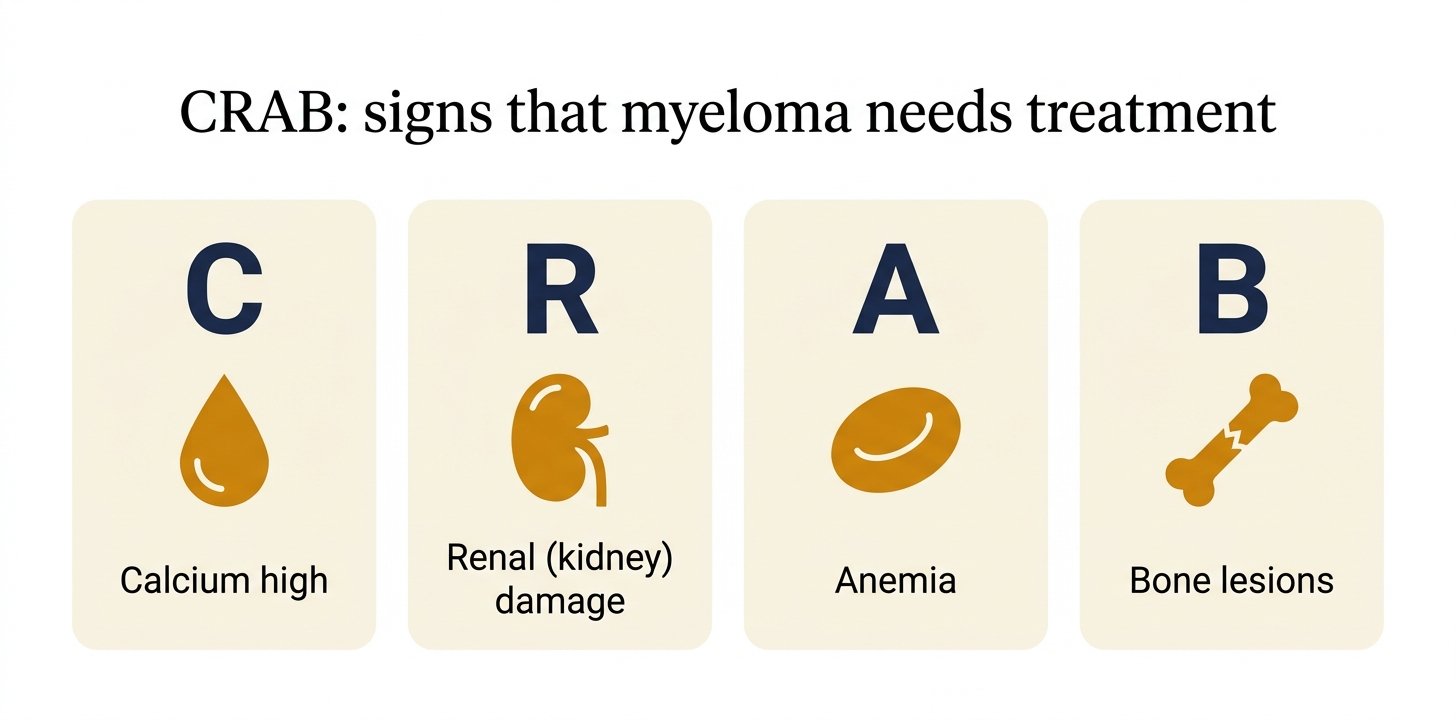
Doctors look for signs of organ damage summarized as CRAB:
- Calcium elevated in the blood
- Renal (kidney) damage
- Anemia (low red blood cells)
- Bone lesions or fractures
Treatment starts when myeloma is active, meaning it causes CRAB features or meets other defined markers. Smoldering myeloma without organ damage is usually monitored, and some high-risk smoldering cases are treated.
Staging and risk
Myeloma is staged with the Revised International Staging System (R-ISS). It combines blood tests (albumin, beta-2 microglobulin, LDH) with genetic findings in the myeloma cells. High-risk genetic changes include del(17p), t(4;14), t(14;16) and gain or amplification of 1q. Risk affects how intensive treatment is and whether maintenance uses one drug or two.
The drug classes used in myeloma
| Drug class | How it works | Drugs | Given as |
|---|---|---|---|
| Immunomodulatory drugs (IMiDs) | Act on the cereblon protein to kill myeloma cells and boost immune activity | Lenalidomide, pomalidomide, thalidomide | Oral capsules |
| Proteasome inhibitors (PIs) | Block the cell’s protein-recycling system, causing myeloma cells to die | Bortezomib, carfilzomib, ixazomib | Bortezomib: injection under the skin or IV. Carfilzomib: IV. Ixazomib: oral |
| Anti-CD38 antibodies | Target the CD38 protein on myeloma cells | Daratumumab, isatuximab | Injection or IV |
| XPO1 inhibitor | Traps tumor-suppressor proteins inside the cell nucleus | Selinexor | Oral tablet |
| Corticosteroid | Kills myeloma cells directly and boosts other drugs | Dexamethasone | Oral or IV |
| BCMA- and GPRC5D-directed therapies | CAR T-cell therapy, bispecific antibodies and an antibody-drug conjugate | Cilta-cel, ide-cel, teclistamab, elranatamab, linvoseltamab, talquetamab, belantamab mafodotin | Infusion or injection |
Regimen decoder: what the letters mean
Myeloma regimens are named with letters taken from brand names. This table decodes the most common ones. The letters in bold link to product guides where a WHO-GMP certified generic is available through named-patient access.
| Letter | Drug | Brand name the letter comes from | Generic Oncology guide |
|---|---|---|---|
| V (sometimes B) | Bortezomib | Velcade | Bortez 1 mg / 2 mg |
| R | Lenalidomide | Revlimid | Revlixen 10 mg / 25 mg |
| K | Carfilzomib | Kyprolis | Carfilez 10 mg / 30 mg |
| P (in Pd, KPd, PVd) | Pomalidomide | Pomalyst | Pomide 2 mg / 4 mg |
| T | Thalidomide | Thalomid | Thalimide 50 mg / 100 mg |
| X | Selinexor | Xpovio | Selinex 20 mg |
| d | Dexamethasone (low dose) | Generic | Widely available |
| D or Dara | Daratumumab | Darzalex | Not currently sourceable in Bangladesh |
| Isa | Isatuximab | Sarclisa | Not currently sourceable in Bangladesh |
| I | Ixazomib | Ninlaro | Not currently sourceable in Bangladesh |
| C | Cyclophosphamide | Generic | Widely available |
| M | Melphalan | Generic | Widely available |
So VRd is bortezomib, lenalidomide and dexamethasone. KRd is carfilzomib, lenalidomide and dexamethasone. D-VRd adds daratumumab to VRd. Pd is pomalidomide and dexamethasone. XVd is selinexor, bortezomib and dexamethasone.
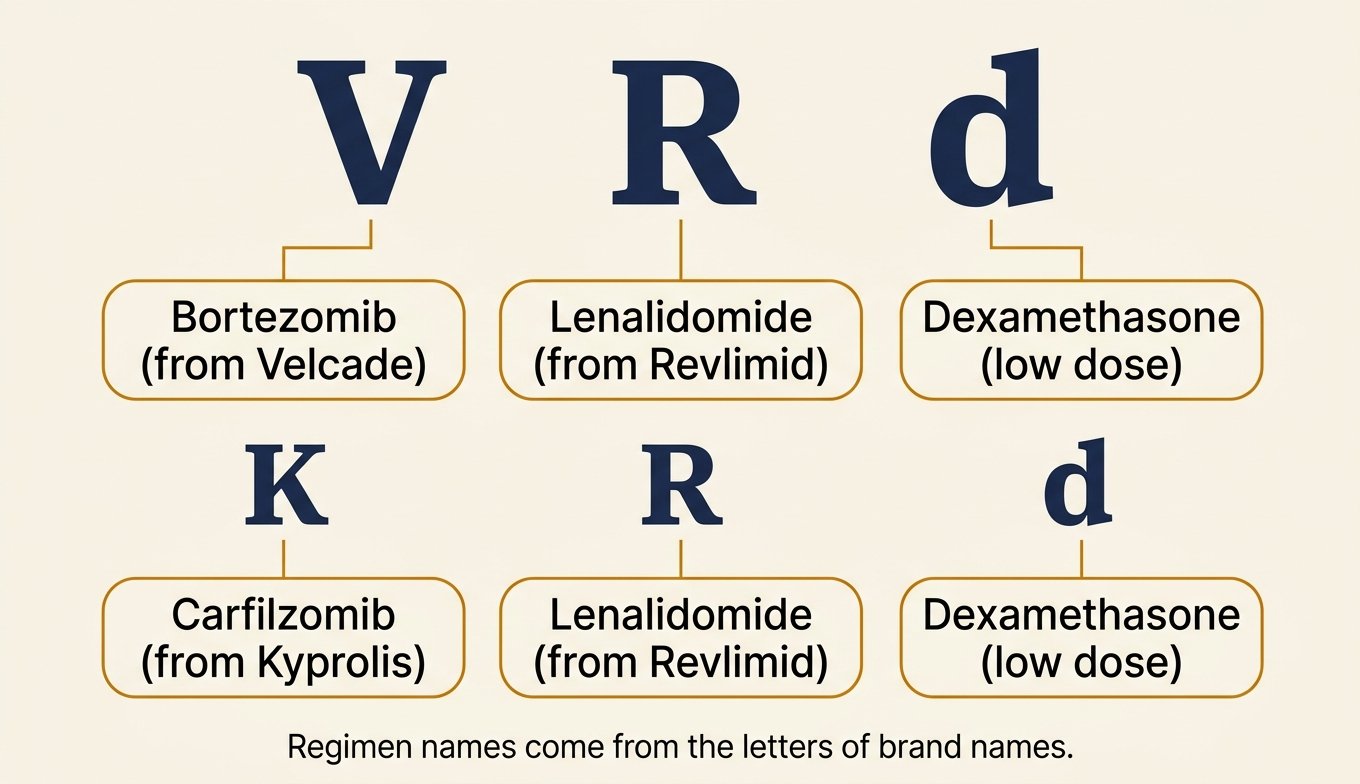
One letter can mean different things. In VMP, the “P” is prednisone, not pomalidomide. A capital “D” usually means daratumumab, while a small “d” means dexamethasone.
First-line treatment for newly diagnosed myeloma
The first decision is whether the patient is a candidate for an autologous stem cell transplant (using their own stem cells). This depends on age, fitness, and other health conditions more than on age alone.
Transplant-eligible patients
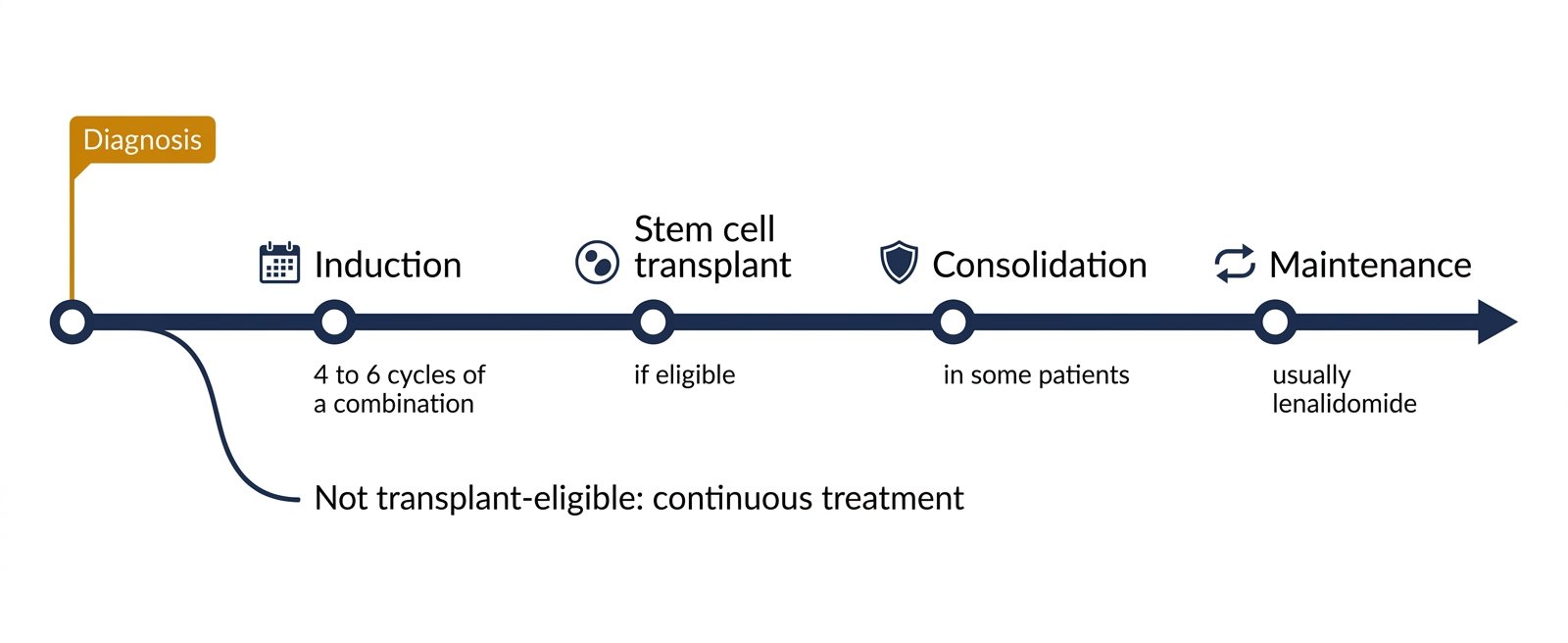
Treatment runs in four phases:
- Induction: usually 4 to 6 cycles of a combination regimen to reduce the disease.
- Stem cell collection and high-dose melphalan followed by autologous stem cell transplant.
- Consolidation: a short course of the induction regimen in some patients.
- Maintenance: lenalidomide, usually continued until progression or intolerance.
The preferred induction in current guidelines is a quadruplet: daratumumab or isatuximab plus VRd. In the PERSEUS trial, 84% of patients given daratumumab plus VRd were alive without progression at about four years, compared with 68% with VRd alone. The US FDA approved this combination for transplant-eligible patients in July 2024.
Three-drug regimens remain standard options, and they are the main options where anti-CD38 antibodies are unavailable:
- VRd (bortezomib, lenalidomide, dexamethasone)
- KRd (carfilzomib, lenalidomide, dexamethasone)
- VTd (bortezomib, thalidomide, dexamethasone), widely used in Europe and in many lower-resource settings
Transplant-ineligible patients
Treatment is continued longer, often until the disease progresses. Options include:
- Isatuximab + VRd: approved by the FDA in September 2024 based on the IMROZ trial, where 63% of patients were progression-free at about five years vs 45% with VRd.
- Daratumumab + VRd: approved by the FDA for this group in January 2026 (CEPHEUS trial), with MRD negativity rates of 60.9% vs 39.4% for VRd.
- DRd (daratumumab, lenalidomide, dexamethasone): a well-established option for older or less fit patients.
- VRd or VRd-lite (reduced dosing): when anti-CD38 antibodies are not available or not tolerated.
- Rd (lenalidomide and dexamethasone) for frail patients.
What is MRD?
Minimal residual disease (MRD) testing looks for tiny numbers of myeloma cells left in the bone marrow after treatment, at a sensitivity of about 1 in 100,000 cells or better. MRD-negative status is linked to longer remissions. It is increasingly used to judge how deep a response is.
Maintenance therapy
After transplant, lenalidomide maintenance is the standard recommendation in both the NCCN and ASCO guidelines. For high-risk disease, doctors may add a second drug, such as bortezomib, carfilzomib or daratumumab.
Lenalidomide dosing depends on kidney function. Patients with reduced kidney function often need 2.5 mg, 5 mg or 15 mg doses. At the time of writing, Bangladeshi manufacturers supply lenalidomide mainly in 10 mg and 25 mg strengths. Patients who need a reduced strength should discuss dose options with their oncologist before ordering.
Treatment at relapse
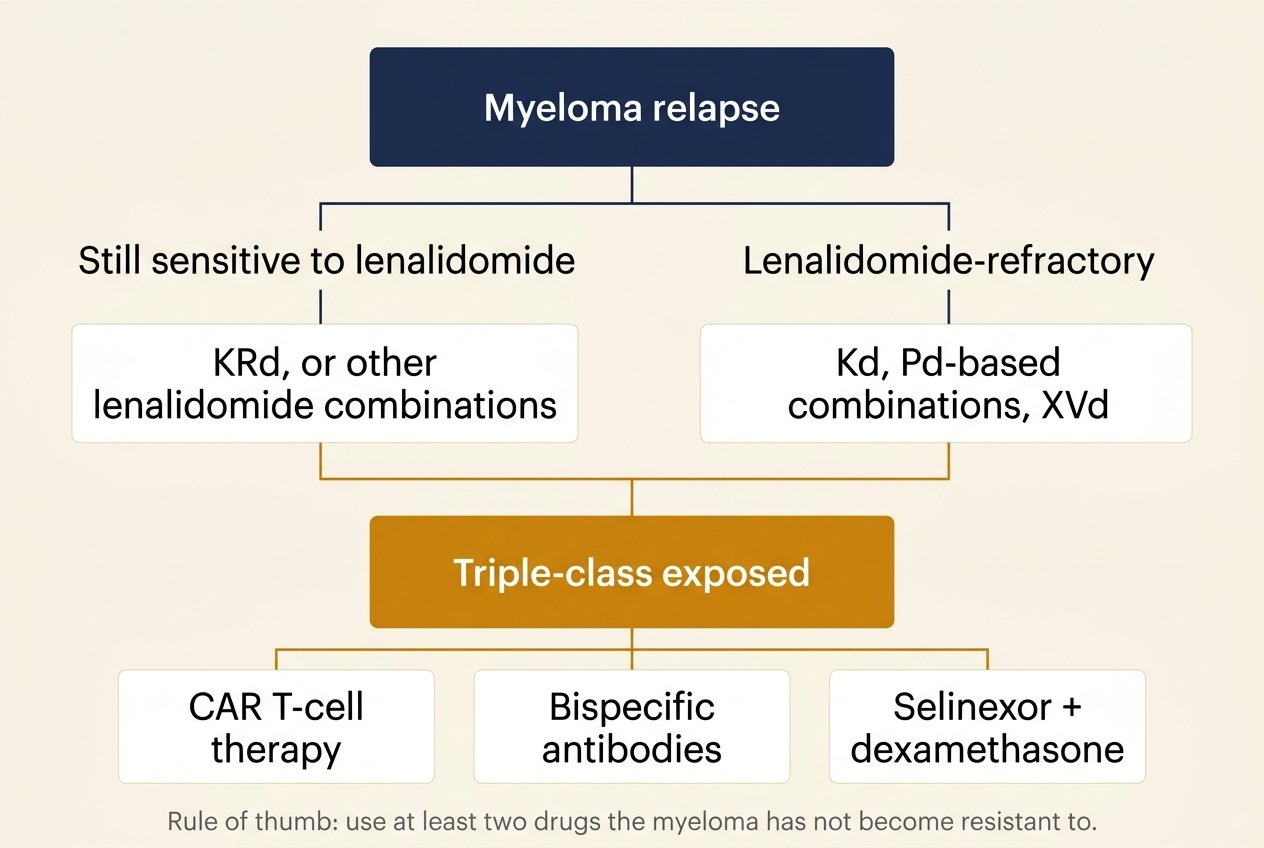
Almost all patients with myeloma relapse at some point, and treatment then moves to a new combination. The general rule is to use at least two drugs the myeloma has not become resistant to, ideally from a different class than the last regimen.
A patient is called lenalidomide-refractory if the disease progressed while on lenalidomide or within 60 days of stopping it. This is common after maintenance and shapes the next choice.
First relapse (1 to 3 prior lines)
| Regimen | Drugs | Common use |
|---|---|---|
| Kd | Carfilzomib + dexamethasone | Lenalidomide-refractory disease |
| KRd | Carfilzomib + lenalidomide + dexamethasone | Disease still sensitive to lenalidomide |
| Pd-based (PVd, KPd, DPd, IsaPd) | Pomalidomide + dexamethasone with a third drug | After lenalidomide and a PI |
| XVd | Selinexor + bortezomib + dexamethasone | After at least one prior therapy |
| DKd, IsaKd, DVd | Anti-CD38 antibody combinations | Where available |
| BVd | Belantamab mafodotin + bortezomib + dexamethasone | After at least two prior therapies (FDA, October 2025) |
In the ENDEAVOR trial of 929 patients, carfilzomib plus dexamethasone (Kd) doubled median progression-free survival compared with bortezomib plus dexamethasone (18.7 vs 9.4 months). It also improved median overall survival (47.6 vs 40.0 months). Grade 2 or worse nerve damage was far less common with carfilzomib (7% vs 35%).
In the BOSTON trial of 402 patients, once-weekly selinexor with bortezomib and dexamethasone extended median progression-free survival from 9.46 to 13.93 months compared with twice-weekly bortezomib and dexamethasone. Because bortezomib was given less often, grade 2 or worse nerve damage was also lower (21.0% vs 34.3%).
Later relapses (triple-class exposed)
“Triple-class exposed” means the patient has already received an IMiD, a PI and an anti-CD38 antibody. Options then include:
- CAR T-cell therapy: ciltacabtagene autoleucel (Carvykti) and idecabtagene vicleucel (Abecma).
- Bispecific antibodies: teclistamab, elranatamab, and linvoseltamab (FDA approved July 2025 after at least four prior lines, 70% response rate in LINKER-MM1). Talquetamab targets GPRC5D.
- Selinexor with dexamethasone (Xd) for heavily pretreated disease.
- Pomalidomide-based combinations not used before.
- Cyclophosphamide- or melphalan-based regimens, and clinical trials.
CAR T-cell therapy and bispecific antibodies are available mainly in the US, Europe and a limited number of other centers. In many countries, the realistic options at later relapse are pomalidomide, carfilzomib and selinexor combinations.
Comparison of the six drugs
The three IMiDs (oral capsules)
| Lenalidomide | Thalidomide | Pomalidomide | |
|---|---|---|---|
| Main setting | Induction, maintenance, relapse | Induction (VTd), older regimens | Relapse after lenalidomide and a PI |
| Key risks | Blood clots, low blood counts, birth defects | Blood clots, nerve damage, drowsiness, birth defects | Blood clots, low blood counts, birth defects |
| US boxed warning | Embryo-fetal toxicity, blood count toxicity, blood clots | Embryo-fetal toxicity, blood clots | Embryo-fetal toxicity, blood clots |
| Product guide | Revlixen | Thalimide | Pomide |
Proteasome inhibitors and selinexor
| Bortezomib | Carfilzomib | Selinexor | |
|---|---|---|---|
| Given as | Injection under the skin (or IV) | IV infusion | Oral tablet, once weekly |
| Main setting | Induction and relapse | Relapse; KRd induction | Relapse |
| Key risks | Nerve damage (neuropathy), shingles reactivation | Heart and blood-pressure effects, kidney effects | Nausea, weight loss, low sodium, low platelets |
| US boxed warning | None | None | None |
| Product guide | Bortez | Carfilez | Selinex |
How treatment cycles work
Myeloma drugs are given in repeating cycles, usually 21 or 28 days long. Each drug is taken on set days within the cycle, followed by rest days. The table shows the typical day pattern for common regimens. Doses are set by your doctor based on weight, kidney function, age and side effects, so they are not listed here.
| Regimen | Cycle length | Typical day pattern |
|---|---|---|
| VRd | 21 days | Bortezomib on days 1, 4, 8 and 11. Lenalidomide daily on days 1 to 14. Dexamethasone on the days of and after each bortezomib dose |
| VRd-lite (reduced intensity) | 28 or 35 days | Bortezomib once weekly. Lenalidomide daily for 21 days. Lower-dose dexamethasone |
| KRd | 28 days | Carfilzomib on days 1, 2, 8, 9, 15 and 16. Lenalidomide daily on days 1 to 21. Dexamethasone weekly |
| Kd (once-weekly) | 28 days | Carfilzomib on days 1, 8 and 15. Dexamethasone weekly |
| Pd | 28 days | Pomalidomide daily on days 1 to 21. Dexamethasone on days 1, 8, 15 and 22 |
| XVd | 35 days | Selinexor once weekly. Bortezomib once weekly for 4 weeks. Dexamethasone twice weekly |
| Lenalidomide maintenance | 28 days | Lenalidomide daily, either on days 1 to 21 or continuously, depending on the doctor’s plan |
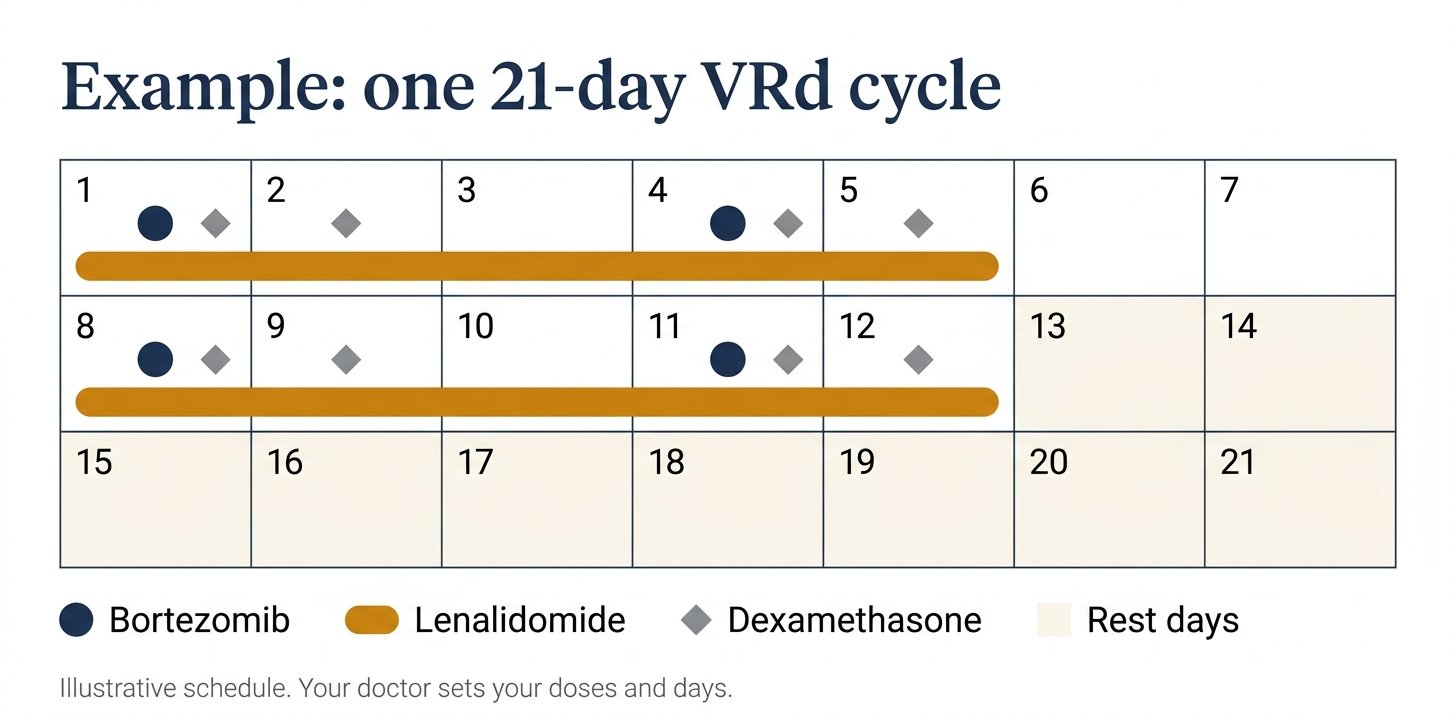
Missing a dose or changing the schedule without advice can reduce how well treatment works. Keep a treatment diary and bring it to every appointment.
Managing side effects
Blood clots with IMiDs
People with myeloma already have a higher risk of blood clots, especially in the first six months after diagnosis. The risk rises further with lenalidomide, thalidomide and pomalidomide, particularly when they are combined with dexamethasone. Most patients receive clot prevention: aspirin for lower-risk patients, or a blood thinner such as low-molecular-weight heparin for higher-risk patients.
Pregnancy prevention with IMiDs
Lenalidomide, thalidomide and pomalidomide can cause severe birth defects. In the US, they are dispensed only through restricted programs that require pregnancy testing and reliable contraception. Similar precautions apply everywhere, including for male patients, whose partners must also avoid pregnancy.
Nerve damage (peripheral neuropathy)
Bortezomib and thalidomide can cause numbness, tingling or pain in the hands and feet. Giving bortezomib under the skin instead of into a vein lowers this risk without reducing effectiveness. In the trial that compared the two routes, response rates were the same (42%), while grade 2 or worse neuropathy fell from 41% to 24% and grade 3 or worse from 16% to 6%. Weekly rather than twice-weekly dosing lowers the risk further. Carfilzomib causes less neuropathy but needs heart and blood-pressure monitoring.
Infections and shingles
Myeloma and its treatment weaken the immune system. Antiviral prevention against shingles is standard with bortezomib and carfilzomib. Vaccinations and prompt treatment of infections are part of routine care.
Tests you will have during treatment
| Test | What it shows |
|---|---|
| Serum protein electrophoresis (SPEP) and immunofixation | The amount and type of M-protein |
| Serum free light chains | Kappa and lambda light chains, useful when M-protein is low |
| Complete blood count | Anemia and low platelets or white cells |
| Kidney function and calcium | Organ damage from myeloma or from treatment |
| Bone marrow biopsy, including MRD | Depth of response |
| PET-CT or MRI | Bone disease and disease outside the bone marrow |
Access outside the US and Europe
Newer drugs such as daratumumab, isatuximab, CAR T-cell therapy and bispecific antibodies are unavailable or hard to access in many countries. Daratumumab, isatuximab and ixazomib are currently not sourceable from Bangladeshi manufacturers. In these settings, effective treatment still relies on combinations of bortezomib, carfilzomib, lenalidomide, pomalidomide, thalidomide, selinexor and dexamethasone. Generic versions of the six myeloma drugs in our catalog can be sourced through named-patient access. Each product guide names the manufacturer and the strengths available.
Important: WHO-GMP certification applies to the manufacturing facility. FDA approval dates and trial results on this page refer to the originator (brand-name) medicines. They are not FDA approval of any generic product. Treatment decisions belong to your treating hematologist or oncologist.
Have a prescription for myeloma treatment? Send your prescription and latest reports, and we will confirm which WHO-GMP certified options can be sourced for your regimen.
- WhatsApp: +880 1792 288474
- Email: info@genericoncology.com
Frequently asked questions
What is the most common first treatment for multiple myeloma?
Most patients start with a three- or four-drug combination built on bortezomib, lenalidomide and dexamethasone (VRd). Current guidelines prefer adding daratumumab or isatuximab where available. Transplant-eligible patients then usually have a stem cell transplant and lenalidomide maintenance.
What does VRd stand for?
VRd stands for Velcade (bortezomib), Revlimid (lenalidomide) and low-dose dexamethasone. The letters in myeloma regimen names come from the brand names of the drugs.
How long does myeloma treatment last?
Induction usually lasts 4 to 6 months. Maintenance with lenalidomide is typically continued for years, often until the disease progresses or side effects become unmanageable. Transplant-ineligible patients usually stay on treatment continuously.
What happens if myeloma comes back?
Treatment switches to a new combination, ideally with at least two drugs the myeloma has not become resistant to. Common choices after lenalidomide include carfilzomib, pomalidomide and selinexor combinations.
Is thalidomide still used for myeloma?
Yes. Thalidomide is part of VTd, a standard induction regimen in Europe and in many countries where newer drugs are hard to access. It causes more nerve damage and drowsiness than lenalidomide, which is why lenalidomide is preferred where available.
Is carfilzomib better than bortezomib?
In the ENDEAVOR trial, carfilzomib with dexamethasone produced longer progression-free and overall survival than bortezomib with dexamethasone at relapse. Carfilzomib causes less nerve damage but more heart and blood-pressure effects. The choice depends on prior treatment and heart health.
Why do I need a blood thinner with lenalidomide?
Lenalidomide, especially combined with dexamethasone, raises the risk of blood clots in the legs and lungs. Aspirin or a stronger blood thinner is prescribed depending on each patient’s risk.
How much does generic lenalidomide or bortezomib cost outside the US?
Prices depend on the strength, the number of cycles and the destination country. Send your prescription for a quote that includes shipping and documentation for your country.
Can myeloma be cured?
Myeloma is generally considered treatable rather than curable, although modern combinations produce long remissions. Many patients live for many years with sequential lines of treatment.
This page is for educational purposes and does not replace advice from your treating hematologist or oncologist. Treatment options, approvals and availability vary by country and change over time. FDA approvals referenced here apply to originator medicines.
References
- NCCN Guidelines for Patients: Multiple Myeloma, 2026
- NCCN Clinical Practice Guidelines: Multiple Myeloma, Version 5.2026. JNCCN 2026;24(1)
- 2026 NCCN and ASCO multiple myeloma guideline updates (Medthority)
- NCI: FDA approves daratumumab and isatuximab combinations for newly diagnosed myeloma
- Regulatory actions December 2025 to January 2026: D-VRd for transplant-ineligible myeloma (Blood Cancers Today)
- FDA: accelerated approval of linvoseltamab (July 2025)
- FDA approves belantamab mafodotin combination in myeloma (Targeted Oncology)
- Dimopoulos MA et al. Carfilzomib or bortezomib in relapsed or refractory multiple myeloma (ENDEAVOR): interim overall survival analysis. Lancet Oncology 2017
- Grosicki S et al. Once-per-week selinexor, bortezomib, and dexamethasone versus twice-per-week bortezomib and dexamethasone (BOSTON). Lancet 2020
- Moreau P et al. Subcutaneous versus intravenous administration of bortezomib in relapsed multiple myeloma. Lancet Oncology 2011