Sourcing Disclosure: Licensed Bangladesh Global Sourcing Specialist facilitating global access under Named Patient Regulations.
Expert-reviewed clinical data for prescription-only medicine.


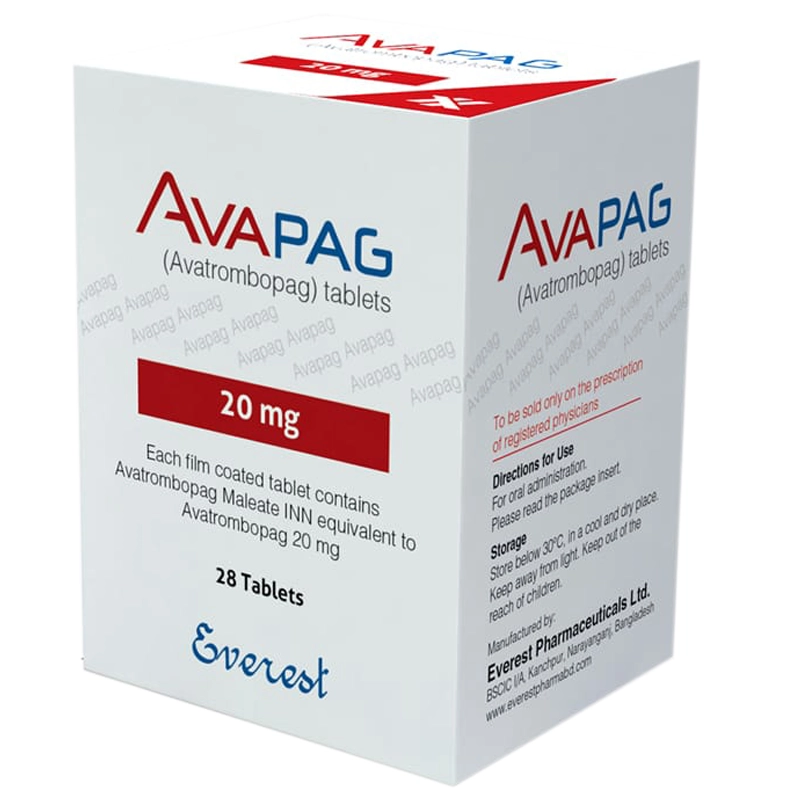
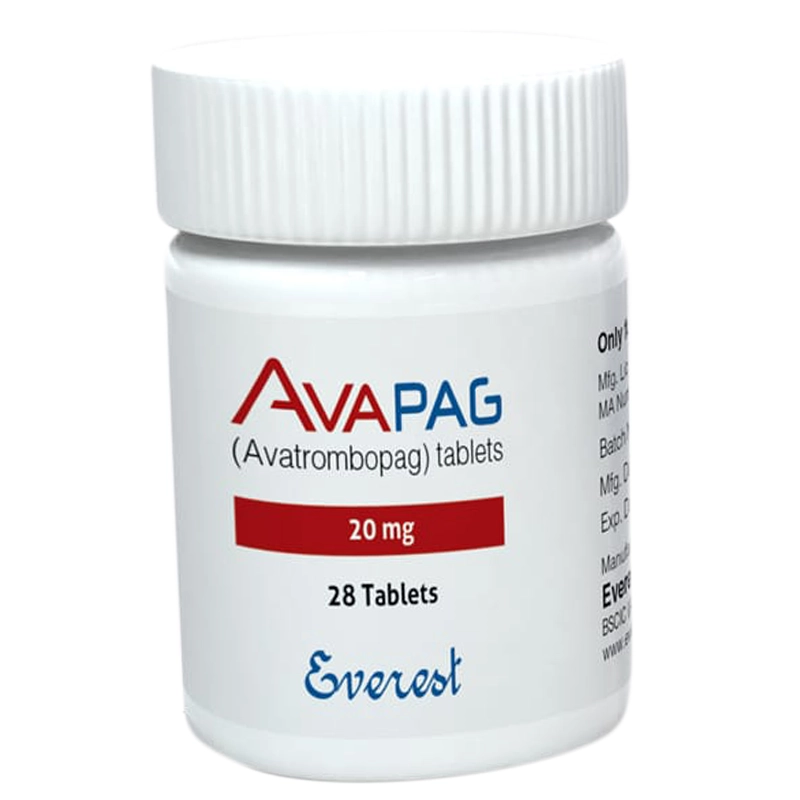
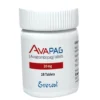
Avapag 20 mg (Avatrombopag) Tablets | Thrombopoietin (TPO) Receptor Agonist
Brand Name: Avapag
Generic Name: Avatrombopag
Therapeutic Class: Thrombopoietin Receptor Agonist
Clinical Indications : Indicated for the treatment of thrombocytopenia in adult patients with chronic liver disease (CLD) or chronic immune thrombocytopenia (ITP).
Available Strength: 20 mg
Pack Size : 28 tablets
- WHO GMP Certified
- Reviewed By Medical Expert
- Batch Examined in Lab
Disclaimer: The following information is for educational and informational purposes only and is not intended as a substitute for professional medical advice, diagnosis, or treatment. Always seek the guidance of your hematologist, oncologist, or other qualified healthcare provider with any questions you may have regarding a medical condition or treatment plan. (Medically Reviewed by Dr Salma Elreedy)
Managing thrombocytopenia—a condition characterized by a low blood platelet count—requires precise, targeted therapy to ensure patient safety, particularly when preparing for surgery or managing a chronic autoimmune condition. Avapag 20 mg, containing the active pharmaceutical ingredient Avatrombopag, is the generic equivalent of Doptelet. It is an oral thrombopoietin (TPO) receptor agonist formulated to stimulate platelet production.
Avapag 20 mg Clinical Guideline and Prescribing Information
Clinical Indications for Avapag 20 mg
According to the FDA approval May-21, 2018, and EMA approval data Avatrombopag has been approved to treat specifically two conditions
- Thrombocytopenia in Chronic Liver Disease (CLD): For patients with liver disease requiring medical or dental procedures, elevating platelet counts is necessary to minimize bleeding risks. Avatrombopag is utilized as a short-term intervention to systematically increase platelets, frequently reducing or eliminating the need for prophylactic platelet transfusions prior to surgery.
- Chronic Immune Thrombocytopenia (ITP): In this autoimmune condition, the immune system prematurely destroys platelets. Avatrombopag is indicated for chronic ITP patients who have demonstrated an insufficient response to previous therapies (such as corticosteroids or immunoglobulins). The goal is to maintain platelet levels within a safe clinical range to prevent spontaneous bleeding.
Mechanism of Action: How Avatrombopag Functions
The human body regulates platelet production through thrombopoietin (TPO), a hormone that signals the bone marrow. Avatrombopag is designed to mimic this endogenous hormone.
As a TPO receptor agonist, it binds directly to the transmembrane region of the TPO receptors located on megakaryocytes (the precursor cells in the bone marrow). This targeted binding triggers a signal transduction cascade that stimulates these cells to mature, proliferate, and release an increased volume of functional platelets into the bloodstream.
Dosage and Administration Protocols
Prescribing guidelines depend entirely on the underlying indication and the patient’s baseline blood work:
- Chronic Liver Disease (Pre-procedure): If the baseline platelet count is below 40 x 10^9/L, the standard protocol is 60 mg (three 20 mg tablets) taken once daily for 5 consecutive days. If the count is between 40 and less than 50 x 10^9/L, the dose is 40 mg (two tablets) once daily for 5 days. Administration must begin exactly 10 to 13 days prior to the scheduled procedure.
- Chronic ITP: The standard starting dose is 20 mg (one tablet) once daily. Treating physicians actively monitor complete blood counts (CBC) and titrate the dose to maintain platelet levels at or above 50 x 10^9/L, utilizing the lowest effective dose necessary to achieve clinical stability.
Clinical Imperative: Avatrombopag must be taken with food. Pharmacokinetic data indicates that administering this medication alongside a meal significantly increases its systemic absorption. Taking the medication on an empty stomach notably reduces drug exposure and clinical efficacy.
Side Effect Management and Safety Efficacy Guide According to Clinical Trials
Safety Efficacy & Clinical Trial
The efficacy of Avatrombopag is documented in phase 3 clinical trials (ADAPT-1 and ADAPT-2) published in leading gastroenterology journals and registered on ClinicalTrials.gov. For CLD patients, data reviewed by the FDA confirms that Avatrombopag provides a statistically significant reduction in the requirement for platelet transfusions or bleeding rescue procedures when compared to a placebo.
For chronic ITP, data published in The Lancet Haematology demonstrates that patients receiving Avatrombopag maintained target platelet counts for significantly longer durations compared to those on placebo, establishing its functional role in chronic disease management.
Adverse Effects and Safety Profile
Based on adverse event reporting from the FDA, EMA, and medical databases such as Medscape, Avatrombopag has a defined safety profile that requires standard medical monitoring:
Commonly Reported Effects:
- In CLD Patients: The most frequently reported adverse events include pyrexia (fever), abdominal pain, nausea, headache, and fatigue.
- In ITP Patients: Common observations include headache, fatigue, contusion (bruising), epistaxis (nosebleeds), upper respiratory tract infections, arthralgia (joint pain), and gingival bleeding.
Significant Clinical Risks to Monitor:
- Thromboembolism: Elevating platelet counts inherently increases the risk of blood clot formation (thrombosis). This includes the risk of deep vein thrombosis (DVT), pulmonary embolism (PE), and portal vein thrombosis, particularly in patients with advanced liver disease or a history of thromboembolic events.
- Rebound Thrombocytopenia: Discontinuing Avatrombopag in ITP patients may result in a rapid return of platelet counts to baseline levels, or temporarily below baseline, requiring careful medical observation to prevent bleeding complications.
Precautions and Special Populations
- Pregnancy and Lactation: Animal reproduction studies indicate potential fetal risk. Avatrombopag is not recommended during pregnancy unless the potential benefit justifies the potential risk. Breastfeeding should be avoided during treatment and for at least two weeks following the final dose.
- Hepatic Impairment: Patients with severe liver disease (Child-Pugh Class C) carry an elevated baseline risk for thromboembolic events; the clinical risk-to-benefit ratio must be evaluated by a hepatologist or hematologist prior to initiation.
Storage Data and Cold Chain Logistics
Avapag 20 mg tablets maintain stability at room temperature. Official manufacturer guidelines specify storage between 20°C to 25°C (68°F to 77°F). During international pharmaceutical distribution, certified exporters utilize climate-controlled logistics to ensure the medication is not subjected to extreme thermal fluctuations during transit, preserving the integrity of the active pharmaceutical ingredient.
Manufacturer Quality Assurance
Avapag 20 mg is manufactured by Everest Pharmaceuticals. For compliance with YMYL (Your Money or Your Life) search standards, establishing manufacturing transparency is vital. Everest Pharmaceuticals operates under World Health Organization Good Manufacturing Practices (WHO GMP) standards. This certification ensures continuous facility auditing and strict batch-testing for API purity, stability, and bioequivalence. This guarantees the generic formulation performs with the same clinical efficacy as the innovator brand (Doptelet).
Global Access to Avatrombopag
International patients can access Avapag 20 mg through verified pharmaceutical exporters, provided their national health ministry or drug distribution authority allows the importation of personal medication.
A valid prescription from a licensed hematologist or medical doctor is legally required to process an order. The dispensing pharmacy’s clinical team verifies the prescription to ensure the medication is dispensed accurately and that the patient remains under active, qualified medical supervision.
Frequently Asked Questions (FAQs)
Is Avapag 20 mg clinically identical to Doptelet?
Yes. Avapag contains Avatrombopag, the exact same active pharmaceutical ingredient found in Doptelet. Because it is manufactured strictly under WHO GMP standards, it is clinically bioequivalent, meaning the body metabolizes it in the exact same manner to stimulate platelet production.
Can treatment be stopped once platelet counts reach the target level?
For patients undergoing a scheduled medical procedure (such as those with liver disease), treatment concludes after the prescribed 5-day course. For patients with chronic ITP, discontinuing the medication without medical supervision can lead to a rapid decline in platelets. Any dosage tapering or cessation must be directed by a treating hematologist.
What is the standard protocol for a missed dose?
If a dose is missed, it should be taken as soon as the patient remembers on the same day. If it is already time for the next scheduled dose, the missed tablet should be skipped, and the normal schedule resumed. Patients must not double a dose to compensate for a missed one, as this increases the risk of thrombotic events.
Are there known drug interactions with Avatrombopag?
Avatrombopag is metabolized through the CYP3A4 and CYP2C9 enzyme pathways. While it does not have extensive contraindications with common over-the-counter drugs, patients must disclose all concurrent medications to their physician—particularly antiviral drugs for Hepatitis C or other targeted enzyme inhibitors—to ensure there are no metabolic conflicts that could alter the drug’s efficacy.
Related products

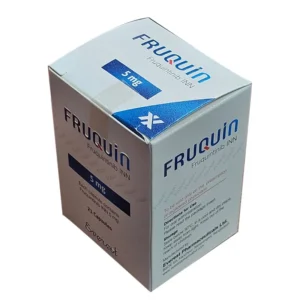
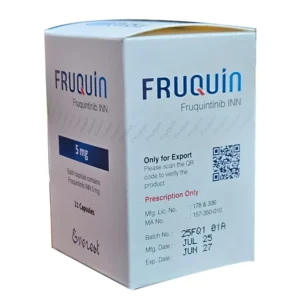
Fruquin 5 mg Tablet (Fruquintinib) | Metastatic Colorectal Cancer Therapy
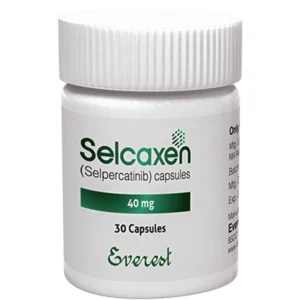
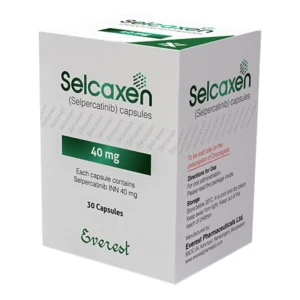
Consult Pharmacist for PriceSelcaxen 40 mg Capsule (Selpercatinib): Clinical Profile and Treatment Overview
Consult Pharmacist for PricePonaxen 45 mg Tablet (Ponatinib) | CML Tyrosine Kinase Inhibitor
Consult Pharmacist for PriceOlanib 150 mg Tablet (Olaparib) | Clinical Overview Of A PARP Inhibitor
Consult Pharmacist for Price