Sourcing Disclosure: Licensed Bangladesh Global Sourcing Specialist facilitating global access under Named Patient Regulations.
Expert-reviewed clinical data for prescription-only medicine.


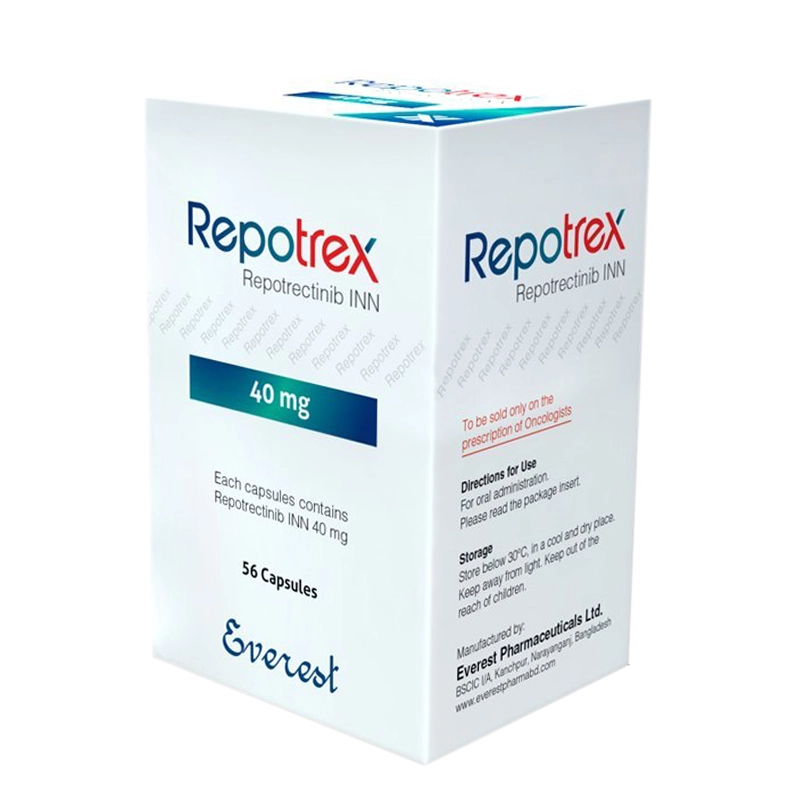
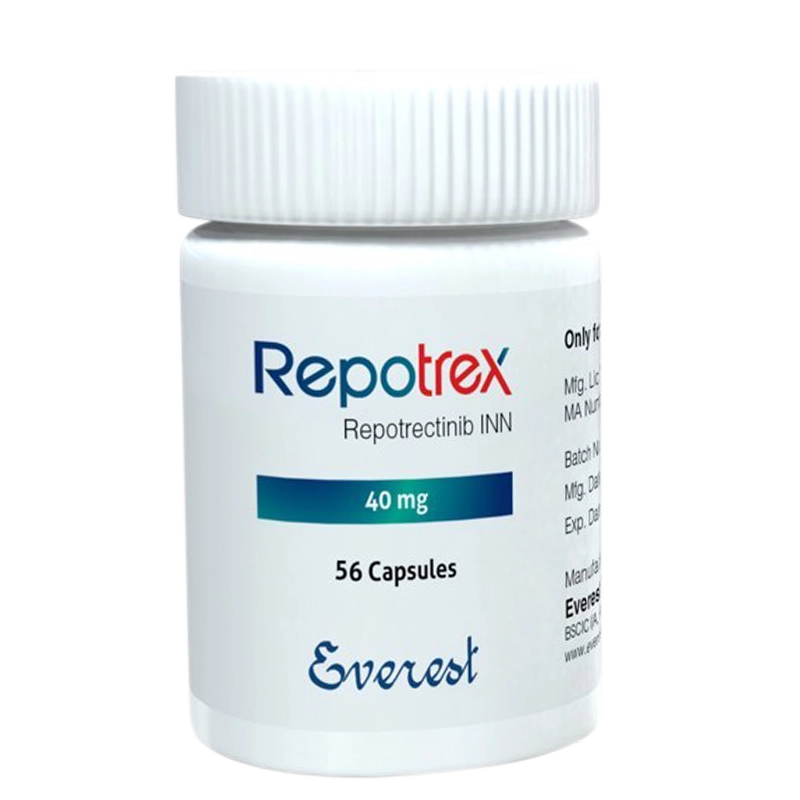
Repotrex 40 mg Capsule (Reptorectinib) | ROS1-positive & NTRK gene fusion-positive Therapy
Author: Salma Abdel
Brand Name: Repotrex
Generic Name: Repotrectinib
Therapeutic Class: Advanced non-small cell lung cancer therapy
Clinical Indications: ROS-1 Positive & NTRK gene fusion positive mutated advanced NSCLC
Available strength: 40 mg
Pack size: 56 capsule
- WHO GMP Certified
- Reviewed By Medical Expert
- Batch Examined in Lab
Medically Reviewed by: Dr. Salma Elreedy, Clinical oncologist, Sphinx Cure Oncology Center
Last Updated: March 7, 2026
Classification: Prescription-Only Medicine (POM)
Prescription-Only Notice: Repotrex 40 mg is a highly potent targeted kinase inhibitor. Unauthorized or unsupervised use can result in severe, potentially life-threatening clinical complications, including interstitial lung disease (ILD) and severe central nervous system toxicity.
Repotrex 40 mg is an advanced, next-generation tyrosine kinase inhibitor (TKI). It is highly selective, engineered specifically to target and suppress tumor growth in solid tumors driven by rare genetic alterations—namely ROS1-positive non-small cell lung cancer (NSCLC) and NTRK gene fusion-positive solid tumors. Unlike earlier-generation therapies, Repotrectinib features a compact macrocyclic structure designed to effectively cross the blood-brain barrier and overcome acquired resistance mutations (such as the ROS1 G2032R solvent-front mutation) that cause older drugs to fail. Manufactured by Everest Pharmaceuticals, Repotrex serves as equivalent active pharmaceutical ingredients to the innovator brand Augtyro, offering durable disease control for both treatment-naïve patients and those who have progressed on prior targeted therapies.
Clinical Consultation: An Oncologist’s Guide to Repotrectinib
Who is the specific candidate for Repotrex therapy?
In clinical practice, we prescribe Repotrex according to FDA regulations, for two very specific groups of patients, confirmed via molecular testing (like Next-Generation Sequencing):
Adults with locally advanced or metastatic ROS1-positive NSCLC.
Adults and pediatric patients (12 years and older) with solid tumors that harbor an NTRK1/2/3 gene fusion. For this group, the cancer must be locally advanced or metastatic, and the patient must have no other satisfactory treatment options or have progressed following prior therapy.
Because this is a tumor-agnostic therapy for NTRK fusions, it doesn’t matter where the cancer originated (lungs, thyroid, colon)—if the fusion is present, Repotrectinib is a clinical option.
How does this medication halt tumor growth at the cellular level?
To understand how it works, picture the ROS1 or NTRK gene fusion as a broken ignition switch in a car, permanently stuck in the “ON” position. This continuously sends signals down the PI3K/AKT and RAS/RAF/MEK/ERK pathways, telling the cancer cells to multiply and survive.
Repotrectinib is a small-molecule inhibitor that binds directly into the ATP-binding pocket of these abnormal kinase proteins, effectively shutting off the engine. What makes Repotrectinib a “next-generation” drug is its rigid, 3D macrocyclic shape. Older drugs like crizotinib are bulky and get blocked when the tumor mutates (a process called steric hindrance). Repotrectinib is small and precise enough to slip into the binding pocket even when resistance mutations are present.
What is the standard dosing and administration protocol?
Because Repotrex is formulated as a 40 mg capsule, the dosing requires specific daily counting. The standard FDA/EMA approved protocol involves a “step-up” approach to help your body adjust:
Days 1 to 14: 160 mg (four 40 mg capsules) taken orally once daily.
Day 15 and onwards: The dose increases to 160 mg (four 40 mg capsules) taken twice daily.
Dietary Requirements: You can take the capsules with or without food. Swallow them whole; do not open, crush, or chew them.
Missed Doses: If you miss a dose, take it as soon as you remember—unless your next scheduled dose is less than 12 hours away. If you are within that 12-hour window, skip the missed dose entirely. Never double your dose. If you vomit after taking the capsules, do not take an extra dose.
What do the clinical trials say about its effectiveness?
The efficacy of Repotrectinib is grounded in the landmark TRIDENT-1 (Phase 1/2) trial, published in The New England Journal of Medicine.
For TKI-naïve ROS1-positive NSCLC patients, the Objective Response Rate (ORR) was an impressive 79%, with a median Progression-Free Survival (PFS) of 35.7 months—a historic benchmark for this mutation.
For patients who had previously progressed on one prior ROS1 TKI, the ORR was 38%, with a median PFS of 9.0 months, proving its ability to overcome acquired resistance.
In pediatric populations, the ongoing CARE study continues to validate its safety and efficacy for younger patients with NTRK-positive tumors.
How do we manage the side effects of Repotrex?
Repotrectinib has a unique side effect profile that requires proactive management. The majority of adverse events are related to its mechanism (TRK inhibition):
Very Common (>20%): Dizziness (58%), dysgeusia (altered taste, 50%), peripheral neuropathy (numbness/tingling), and fatigue.
Actionable Advice: The dizziness is usually low-grade but can be disruptive. Change positions slowly (e.g., sitting to standing). For altered taste, eating cold foods or using plastic utensils instead of metal can help.
Common: Constipation, muscle weakness, and cognitive impairment (trouble concentrating).
Actionable Advice: Maintain high oral hydration and dietary fiber for constipation.
Serious Risks: Interstitial lung disease (ILD)/pneumonitis and hepatotoxicity (liver inflammation).
Adverse Event Warning: Seek emergency medical care if you experience new or worsening shortness of breath, a sudden dry cough, or yellowing of your skin or eyes. Adverse reactions must be reported immediately to your treating oncologist and the manufacturer’s pharmacovigilance unit.
Precautions & Special Populations
Pregnancy & Contraception: Repotrectinib can cause severe embryo-fetal toxicity. Crucial interaction: Repotrectinib induces the CYP3A4 enzyme, which rapidly breaks down the hormones in birth control pills, rendering them ineffective. Female patients must use highly effective non-hormonal contraception (like a copper IUD or barrier methods) during treatment and for 2 months after the final dose.
Pediatric Use: Approved for patients 12 years and older based on weight-based dosing parameters extrapolated from the adult TRIDENT-1 data and pediatric CARE study.
Organ Function: No initial dose adjustments are required for mild to moderate renal or hepatic impairment. However, routine monitoring of liver function tests (LFTs) is mandatory.
Storage Data: Store the medication at standard room temperature, between 20°C and 25°C (68°F to 77°F). No cold-chain logistics are required, but keep the capsules in their original packaging to protect them from moisture.
Manufacturer Quality Assurance & Global Access
Manufacturing Standards: Repotrex is manufactured by Everest Pharmaceuticals, a prominent pharmaceutical manufacturer operating under strict WHO-GMP (World Health Organization Good Manufacturing Practice) guidelines. Every batch of Repotrex undergoes rigorous high-performance liquid chromatography (HPLC) and in-vitro dissolution testing to ensure complete similar efficacy to the innovator brand, Augtyro. This guarantees that the pharmacokinetic profile performs exactly to the standards established in global clinical trials.
Global Access Pathways: For international patients residing in regions where Repotrectinib is not yet locally approved or accessible, Repotrex can be obtained through legal personal importation pathways. Under the “Named Patient Basis,” most national health ministries allow individuals to import life-saving oncology medications for personal use, provided they possess a valid prescription and medical justification from a licensed oncologist.
Frequently Asked Questions (FAQs)
Can Repotrex cross the blood-brain barrier to treat brain metastases?
Yes. One of the primary advantages of this next-generation TKI is its highly lipophilic, compact structure, which allows it to penetrate the central nervous system (CNS) effectively. In the TRIDENT-1 trial, it demonstrated an intracranial response rate of nearly 89% in TKI-naïve patients with measurable brain metastases.
Can I take Repotrex if I am already taking strong medications for infections?
You must exercise extreme caution. Repotrectinib is metabolized by the CYP3A4 enzyme. Taking it alongside strong CYP3A4 inhibitors (like fluconazole or itraconazole) can dangerously spike the levels of Repotrectinib in your blood. Conversely, strong inducers (like rifampin) will clear it from your body too fast. Always have your oncologist review your entire medication list.
Why do I only take it once a day for the first 14 days?
Repotrectinib exhibits “time-dependent auto-induction.” This means the drug actually teaches your liver enzymes to break it down faster over time. We start at 160 mg once daily to let your body adjust to the central nervous system side effects (like dizziness). After 14 days, your liver is processing it faster, so we increase the dose to twice daily to maintain therapeutic levels in your tumor.
Does this drug cause myalgia (muscle pain)?
Yes, myalgia occurs in about 13% of patients, and it can sometimes be accompanied by an elevation in an enzyme called Creatine Phosphokinase (CPK). Your doctor will monitor your CPK levels through routine blood work, especially during the first month of therapy.
General Medical Disclaimer: This clinical monograph is provided by genericoncology.com for informational and educational purposes only. It does not constitute professional medical advice, diagnosis, or a treatment recommendation. Management of oncology medications must be strictly directed by a licensed oncology specialist.
Related products

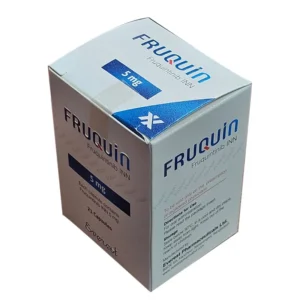
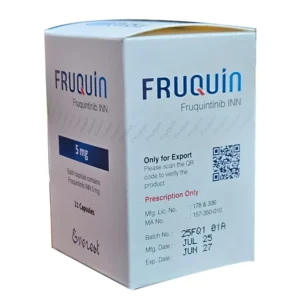
Fruquin 5 mg Tablet (Fruquintinib) | Metastatic Colorectal Cancer Therapy
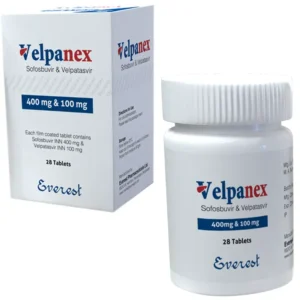
Consult Pharmacist for PriceVelpanex (Sofosbuvir + Velpatasvir) 100 mg + 400 mg | HCV Direct Acting Antiviral
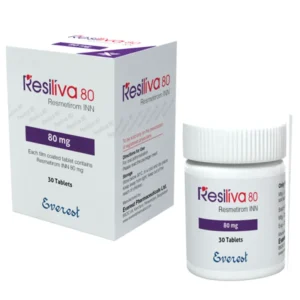
Consult Pharmacist for PriceResiliva 80 mg Tablet (Resmetirom)| Global Acces Named Patient Guide to Generic Rezdiffra
Consult Pharmacist for PriceAvapag 20 mg (Avatrombopag) Tablets | Thrombopoietin (TPO) Receptor Agonist
Consult Pharmacist for Price

Reviews
There are no reviews yet.