Prescription required. We facilitate access to medicines already prescribed by your treating physician. We do not provide medical advice or diagnoses.


CML Treatment: Imatinib vs Dasatinib vs Ponatinib vs Asciminib

Medically reviewed by Dr. Salma Mamdouh Elreedy, Clinical Oncologist, Sphinx Cure Oncology Center. Last reviewed: [September 2026]
Chronic myeloid leukemia (CML) treatment is built around daily tablets called tyrosine kinase inhibitors (TKIs), which block the BCR-ABL protein (written BCR::ABL1 in newer lab reports) that drives the disease. Most people in chronic phase who take their TKI consistently now have a near-normal life expectancy. The choice between imatinib, dasatinib, nilotinib, bosutinib, asciminib and ponatinib depends on the treatment line, side-effect risks, other health conditions and, in resistant disease, specific mutations such as T315I.
Key facts
- CML is monitored with a BCR-ABL PCR blood test. The results at 3, 6 and 12 months show whether the TKI is working.
- The European LeukemiaNet guideline treats imatinib, dasatinib, nilotinib and bosutinib as valid first choices, with side effects and other illnesses guiding the pick. Asciminib was added as a first-line option in the US in 2024.
- The T315I mutation makes CML resistant to imatinib, dasatinib, nilotinib and bosutinib. Ponatinib and asciminib work against it.
- Some patients with long, deep responses can stop treatment under close monitoring. This is called treatment-free remission.
What is CML?
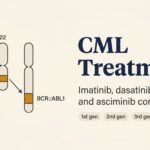
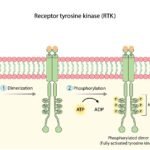
CML is a cancer of the blood-forming cells in the bone marrow. It is caused by a swap between chromosomes 9 and 22 that creates the Philadelphia chromosome. This produces a fusion gene, BCR::ABL1, which makes an always-on tyrosine kinase that drives white blood cells to multiply.
CML is described in phases:
- Chronic phase: about 90% of people are diagnosed in this phase. Blasts (immature cells) are low, and TKIs work very well.
- Accelerated phase and blast phase: more advanced stages with rising blasts. Blast phase behaves like acute leukemia and needs more intensive treatment.
Treatment in advanced phases
Accelerated-phase CML is usually treated with a second- or third-generation TKI, often at a higher dose. Blast-phase CML is treated like acute leukemia: a TKI combined with chemotherapy, followed by an allogeneic (donor) stem cell transplant in patients who are fit enough. Mutation testing is done straight away because it decides which TKI will work. This page focuses on chronic phase, where most patients are diagnosed.
Risk scores at diagnosis
Doctors calculate a risk score at diagnosis using age, spleen size, platelet count and the percentage of blasts in the blood. The ELN 2020 recommendations prefer the ELTS score, which predicts the risk of dying from CML. The older Sokal score is still widely reported. A high-risk score often favors a second-generation TKI for a faster response.
Before TKIs, CML usually progressed to blast phase within a few years. In the IRIS trial, the first large study of imatinib, 83% of patients were alive at 10 years.
How TKIs work, and why there are several
All CML drugs target BCR::ABL1, but in different ways.
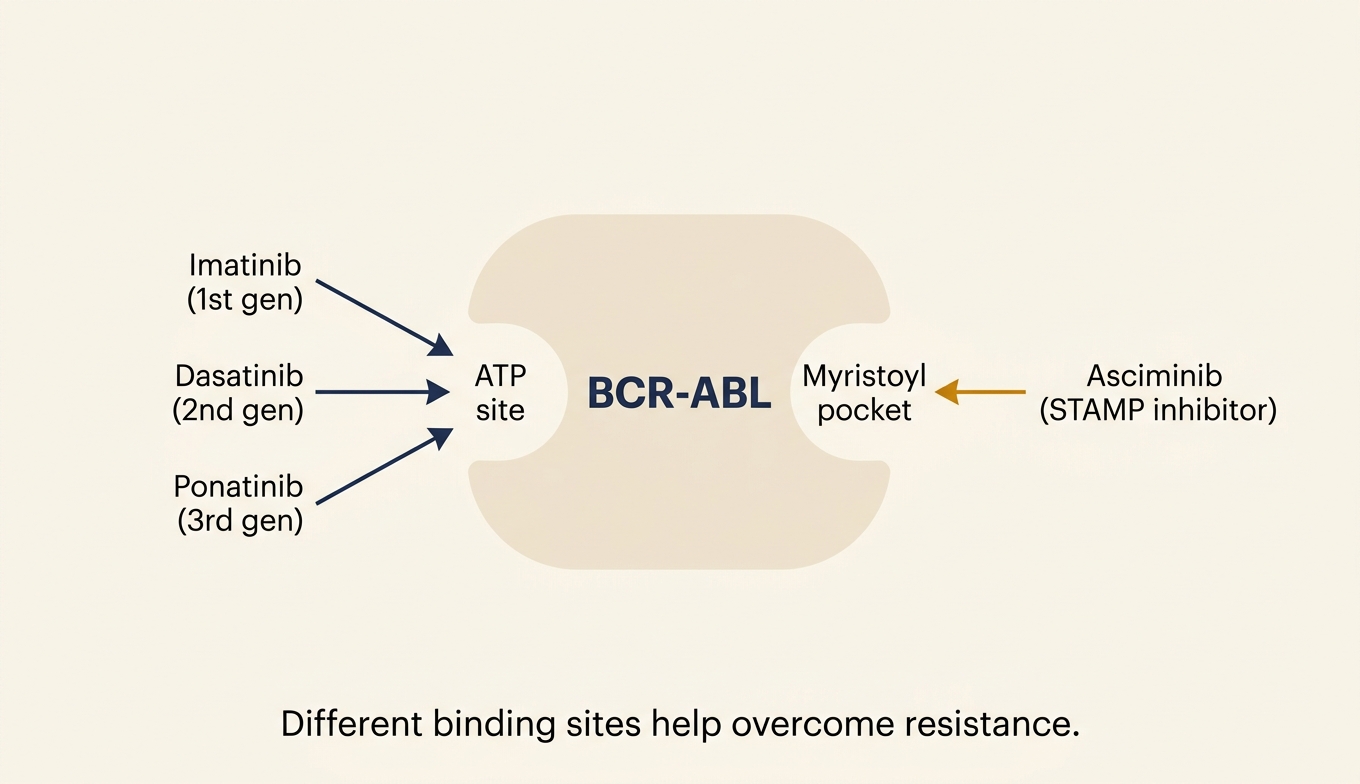
| Generation | Drug | How it binds | Key feature |
|---|---|---|---|
| First | Imatinib | ATP-binding site | Longest track record; the reference standard since 2001 |
| Second | Dasatinib, nilotinib, bosutinib | ATP-binding site, more potently | Faster and deeper responses than imatinib |
| Third | Ponatinib | ATP-binding site, designed to fit around T315I | Works against T315I and most other resistance mutations |
| STAMP inhibitor | Asciminib | A different site (the myristoyl pocket) | Different mechanism; works when ATP-site drugs have failed, and against T315I at a higher dose |
“STAMP” stands for Specifically Targeting the ABL Myristoyl Pocket. Because asciminib binds a different part of the protein, many mutations that block the other TKIs do not affect it.
Monitoring: how to read your BCR-ABL test result
In the first weeks of treatment, blood counts are checked every 2 weeks until they return to normal (complete hematologic response). After that, response is measured with a quantitative BCR-ABL PCR blood test. Newer reports may write it as BCR::ABL1; it is the same test. The result is reported on the International Scale (IS) as a percentage. Lower is better.
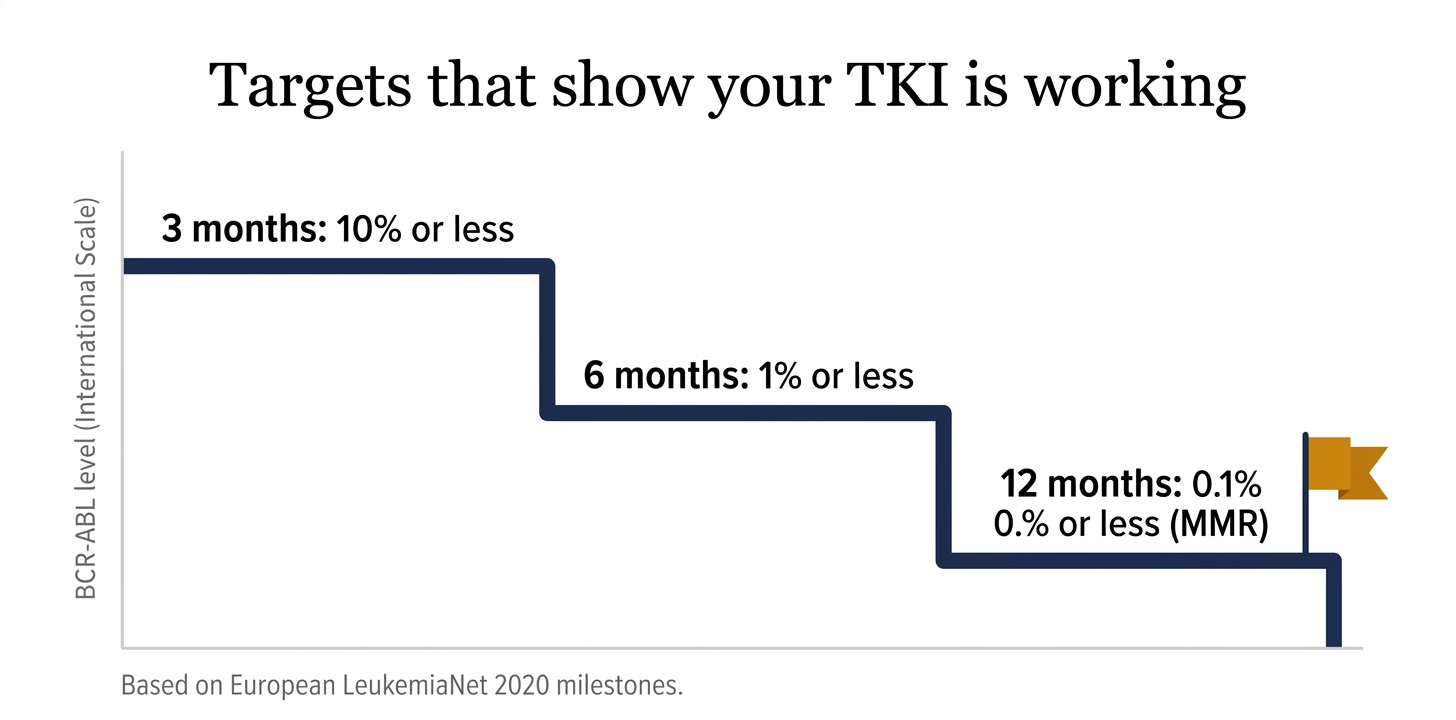
| BCR-ABL result (IS) | Name | What it means |
|---|---|---|
| 10% or less | Early molecular response | The target at 3 months |
| 1% or less | Roughly equal to complete cytogenetic response | The target at 6 months |
| 0.1% or less | Major molecular response (MMR, MR3) | The target at 12 months |
| 0.01% or less | MR4 (deep molecular response) | Needed, with other criteria, before trying to stop treatment |
| 0.0032% or less | MR4.5 | An even deeper response |
The European LeukemiaNet (ELN) 2020 recommendations use these milestones:
| Time on treatment | Optimal | Warning | Failure |
|---|---|---|---|
| 3 months | 10% or less | Above 10% | Above 10%, if confirmed within 1 to 3 months |
| 6 months | 1% or less | Above 1% to 10% | Above 10% |
| 12 months | 0.1% or less | Above 0.1% to 1% | Above 1% |
| Any time after | 0.1% or less | Above 0.1% to 1% | Above 1%, resistance mutations, or new chromosome changes |
At 3 months, a single result above 10% counts as a warning. If a repeat test within 1 to 3 months is still above 10%, it counts as failure.
A “warning” result means closer monitoring and a check on whether doses are being missed. A “failure” result usually means switching TKI and testing for resistance mutations. PCR testing is recommended at least every 3 months, even after MMR is reached.
Tip: Results from different laboratories can differ. Where possible, use a lab that reports on the International Scale and use the same lab for every test.
First-line treatment
Imatinib
Imatinib has more than 20 years of data and remains a guideline-endorsed first choice. The ELN lists generic imatinib as an appropriate starting option. The standard dose in chronic phase is 400 mg once daily, taken with a meal and a large glass of water.
- Strengths: long safety record, predictable side effects, few serious heart or lung effects.
- Common side effects: fluid retention (puffy eyes, swollen ankles), muscle cramps, nausea, diarrhea, rash, fatigue.
- Limitation: responses are slower and less deep than with second-generation TKIs.
Product guide: [Imaxen 100 mg / 400 mg (imatinib)]([PLACEHOLDER: Imaxen URL])
Dasatinib
Dasatinib is a second-generation TKI, usually taken as 100 mg once daily, with or without food. In the DASISION trial, which compared it directly with imatinib, dasatinib produced more and faster deep responses. At 5 years, MMR was 76% vs 64%, and MR4.5 was 42% vs 33%. Overall survival was similar in both groups (91% vs 90%).
- Strengths: faster, deeper responses, which matter for patients who hope to stop treatment one day.
- Key risk: fluid around the lungs (pleural effusion) developed in 28% of patients on dasatinib vs under 1% on imatinib over 5 years. It was more common in people aged 65 or older. A rarer risk is high blood pressure in the lungs (pulmonary arterial hypertension).
- Interaction: acid-reducing medicines lower dasatinib absorption. Proton pump inhibitors such as omeprazole should be avoided, and antacids taken at least 2 hours before or after a dose.
Lower-dose dasatinib (50 mg)
A growing body of evidence supports starting dasatinib at 50 mg daily instead of 100 mg. In a 2026 study comparing the two doses as first treatment, MMR at 12 months was the same (59.1% with 50 mg vs 58.3% with 100 mg). Pleural effusion was far less common (2.2% vs 25.2%). Earlier experience at MD Anderson Cancer Center pointed the same way. These studies were observational rather than randomized, and 100 mg remains the labeled starting dose, so the choice belongs to the treating hematologist. Lower dosing may suit older patients or those at higher risk of lung side effects.
Product guide: [Dasanix 20 mg / 50 mg / 100 mg (dasatinib)]([PLACEHOLDER: Dasanix URL])
Nilotinib and bosutinib
Nilotinib and bosutinib are the other second-generation options. Nilotinib is taken twice daily on an empty stomach and carries risks of heart rhythm changes (QT prolongation) and artery narrowing. Bosutinib mainly causes diarrhea and liver enzyme changes. [PLACEHOLDER: link Nilonix once the product page is live]
Asciminib as a first-line option
In October 2024, the FDA granted accelerated approval to asciminib for newly diagnosed chronic-phase CML. In the ASC4FIRST trial of 405 patients, 68% on asciminib reached MMR at 48 weeks, compared with 49% on the other TKIs (the doctor’s choice of imatinib, nilotinib, dasatinib or bosutinib). Compared with imatinib alone, MMR was 69% vs 40%. Access to first-line asciminib varies by country.
How doctors choose a first-line TKI
| Factor | Often favors |
|---|---|
| Heart disease, diabetes or artery disease | Imatinib or dasatinib over nilotinib |
| Lung disease or pleural effusion history | Imatinib or nilotinib over dasatinib |
| Younger patient hoping to stop treatment one day | A second-generation TKI or asciminib, for faster deep response |
| Higher-risk disease at diagnosis (Sokal or ELTS score) | A second-generation TKI |
| Long-term availability in many countries | Generic imatinib |
| Needs to take the drug with food | Imatinib or dasatinib |
When the first TKI is not working
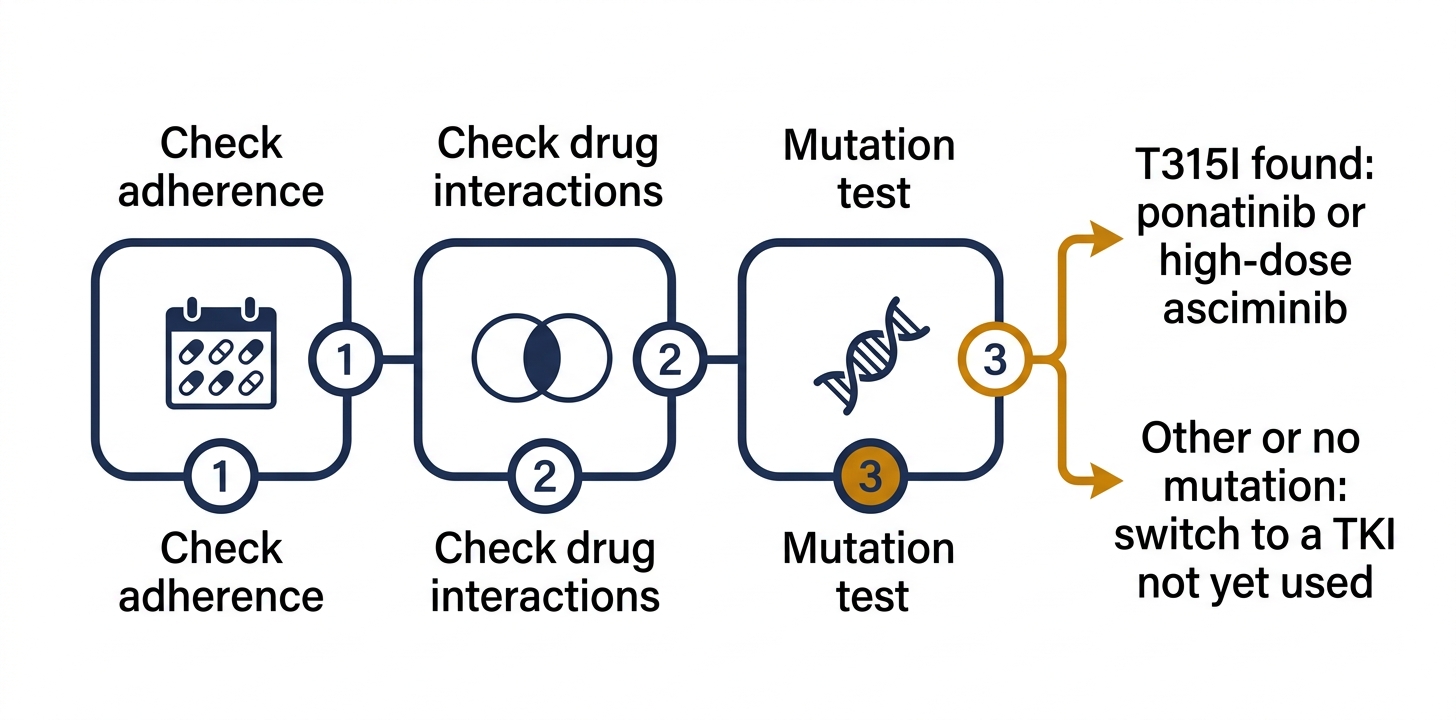
Switching is recommended after a “failure” result or when side effects cannot be controlled. Before switching, doctors check:
- Adherence. Missed doses are the most common reason for poor response. Taking the TKI every day matters more than which TKI it is.
- Drug interactions, such as acid reducers with dasatinib.
- Mutation testing. A BCR::ABL1 kinase domain mutation test shows which TKIs will still work.
| Mutation found | TKIs likely to work |
|---|---|
| T315I | Ponatinib; asciminib (at the higher dose) |
| F317L/V/I/C, T315A | Nilotinib, bosutinib, ponatinib (avoid dasatinib) |
| V299L | Nilotinib, ponatinib (avoid dasatinib and bosutinib) |
| Y253H, E255K/V, F359V/C/I | Dasatinib, bosutinib, ponatinib (avoid nilotinib) |
| No mutation | Any TKI not yet used, chosen by side-effect profile |
Asciminib’s activity depends on the specific mutation, because it binds a different site. Your hematologist will interpret the full mutation report. [PLACEHOLDER: reviewer to confirm this table against the current NCCN CML mutation table]
Third-line treatment and T315I
Ponatinib
Ponatinib is approved for chronic-phase CML after resistance or intolerance to at least two prior TKIs, and for T315I-positive disease. The OPTIC trial showed that doses can be adjusted to response. Patients start at 45 mg daily and reduce to 15 mg once BCR::ABL1 falls to 1% or less. In this group, 42% reached 1% or less at 12 months.
- Key risk: blood vessel blockages (arterial occlusive events) such as heart attack and stroke. These occurred in 13% of patients on the 45 mg-to-15 mg schedule in OPTIC. Ponatinib’s US label also carries boxed warnings for heart failure and liver toxicity.
- Before starting: blood pressure, cholesterol and blood sugar should be controlled, and heart risk assessed.
Strength note: Ponaxen is supplied as a 45 mg tablet. [PLACEHOLDER: choose one. (a) “A 15 mg strength is also available for the step-down dose.” or (b) “A 15 mg strength is not currently available from Bangladeshi manufacturers. Patients who reach the step-down point should discuss options with their hematologist before ordering.”]
Product guide: Ponaxen 45 mg (ponatinib)
Asciminib
Asciminib is approved for chronic-phase CML after at least two prior TKIs, and at a higher dose for T315I. In the ASCEMBL trial against bosutinib, 25.5% of patients on asciminib reached MMR at 24 weeks, compared with 13.2% on bosutinib. Only 5.1% stopped asciminib because of side effects, compared with 21.1% for bosutinib.
- Dose: 80 mg once daily or 40 mg twice daily. For T315I, the dose is 200 mg twice daily. With 40 mg tablets, the standard dose is 2 tablets a day, while the T315I dose is 10 tablets a day (5 twice daily). Plan supply and cost with your hematologist before starting the higher dose.
- How to take it: on an empty stomach (no food for 2 hours before and 1 hour after).
- Side effects: generally mild. They include musculoskeletal pain, fatigue, rash and low blood counts. Pancreatic enzyme rises need monitoring.
Product guide: Ascimib 40 mg (asciminib)
Comparison of the four drugs
First-line options
| Imatinib | Dasatinib | |
|---|---|---|
| Usual chronic-phase dose | 400 mg once daily | 100 mg once daily (50 mg increasingly used) |
| Take with food? | Yes, with a meal | With or without food |
| Main strength | Longest safety record | Faster, deeper responses |
| Main risks | Fluid retention, cramps, nausea | Pleural effusion, pulmonary hypertension, low platelets |
| Key interaction | Strong CYP3A4 drugs | Acid reducers (avoid PPIs) |
| Product guide | [Imaxen]([PLACEHOLDER: Imaxen URL]) | [Dasanix]([PLACEHOLDER: Dasanix URL]) |
Later-line and T315I options
| Ponatinib | Asciminib | |
|---|---|---|
| Usual dose | 45 mg daily, reduced to 15 mg at 1% or less | 80 mg daily (200 mg twice daily for T315I) |
| Take with food? | With or without food | Empty stomach |
| Works against T315I | Yes | Yes, at the higher dose |
| Main risks | Arterial blockages, heart failure, liver toxicity, high blood pressure | Pancreatic enzyme rise, low blood counts, musculoskeletal pain |
| US boxed warning | Yes | No |
| Product guide | Ponaxen | Ascimib |
Treatment-free remission: can CML treatment be stopped?
Some patients with a long, stable deep response can stop their TKI and remain in remission. This is called treatment-free remission (TFR). It should only be attempted under a specialist’s supervision.
Commonly used criteria (NCCN):
- Age 18 or older
- Chronic-phase CML, with no history of accelerated or blast phase
- On a TKI for at least 3 years
- Stable MR4 (BCR::ABL1 0.01% or less) for at least 2 years, confirmed on at least 4 tests done at least 3 months apart
- Access to a reliable International Scale PCR lab that can deliver results within about 2 weeks
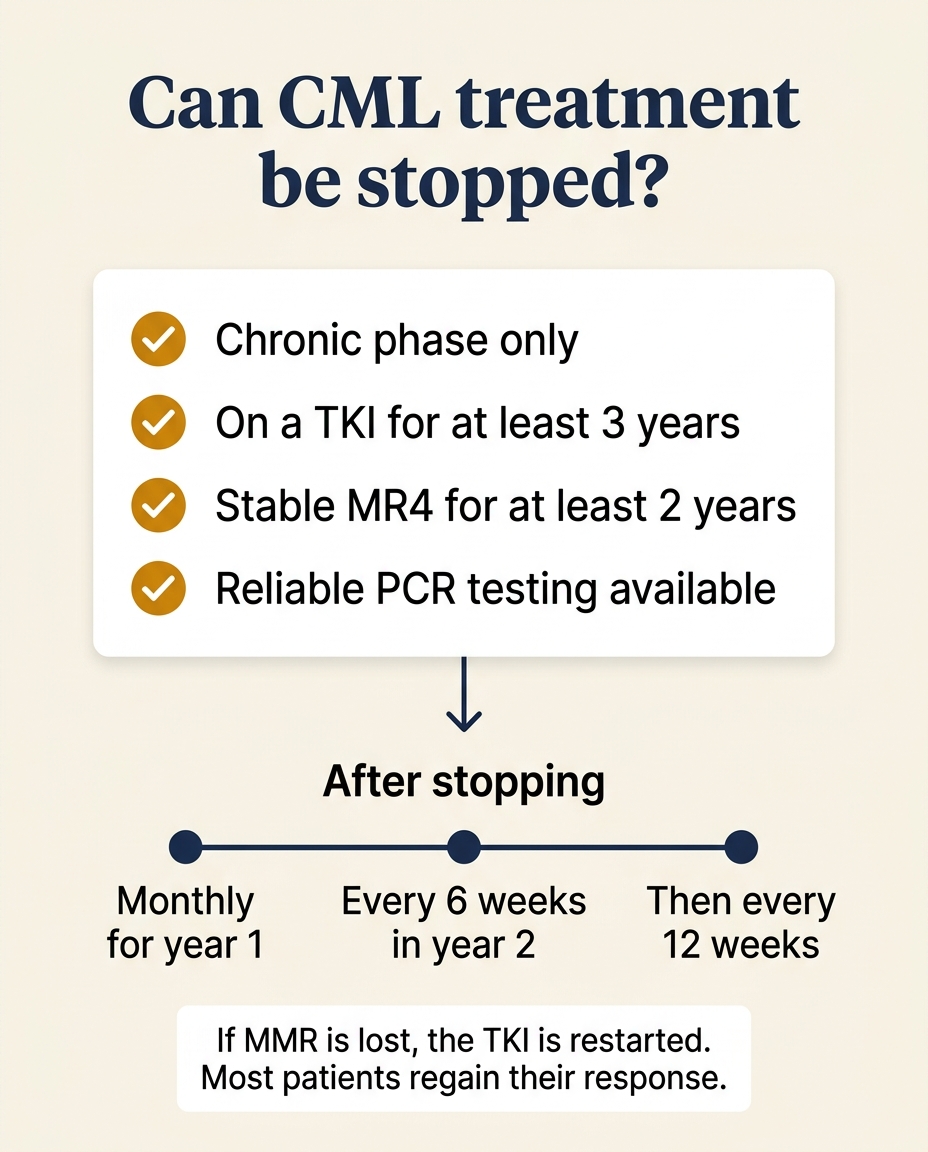
After stopping, the BCR-ABL test is repeated often. The NCCN schedule has been monthly for the first year, every 6 weeks in the second year, and every 12 weeks after that. [PLACEHOLDER: reviewer to confirm against the current NCCN version] If MMR is lost, the TKI is restarted.
What to expect: in EURO-SKI, the largest European stopping trial, patients had taken a TKI for at least 3 years and had been in MR4 for at least 1 year. Of these patients, 46% were still in remission without treatment at 3 years. Most relapses happen in the first 6 months, and patients who restart their TKI usually regain their response.
Stricter selection leads to higher success. In a study from a tertiary cancer center in India, patients had to have taken imatinib for at least 8 years, with MMR for 5 years and MR4 for at least 3 years. Among these 69 patients, 80% remained in remission at one year. Of the 12 who restarted imatinib after relapse, 11 regained MMR and none progressed.
Some people get muscle and joint aches for a few weeks or months after stopping, known as TKI withdrawal syndrome.
Living with a daily TKI
- Take it every day. Adherence has the largest effect on long-term response. Use a phone reminder or pill box.
- Check every new medicine. Many drugs, supplements and grapefruit interact with TKIs.
- Pregnancy planning. TKIs can harm an unborn baby. Imatinib requires effective contraception during treatment and for 14 days after the last dose, and other TKIs have their own time windows. Women planning pregnancy should discuss timing and TFR with their hematologist.
- Keep your PCR reports. They are needed to confirm response, to switch TKI, and for named-patient access.
Access outside the US and Europe
Generic imatinib and dasatinib are widely produced, and the ELN lists generic imatinib as an appropriate first-line choice. Later-line drugs such as ponatinib and asciminib are harder to obtain in many countries. Reliable International Scale PCR testing can also be a barrier, and it is essential for safe TFR.
Important: WHO-GMP certification applies to the manufacturing facility. FDA approval dates and trial results on this page refer to the originator (brand-name) medicines. They are not FDA approval of any generic product. Treatment decisions belong to your treating hematologist or oncologist.
Have a prescription for a CML treatment? Send your prescription and latest BCR::ABL1 report, and we will confirm which WHO-GMP certified options can be sourced.
- Email: [email protected]
Frequently asked questions
What is the best first treatment for CML?
There is no single best choice. Imatinib, dasatinib, nilotinib, bosutinib and asciminib are all approved first-line in the US. Second-generation TKIs and asciminib give faster, deeper responses, while imatinib has the longest safety record. Overall survival has been similar in head-to-head trials, so side effects and other health conditions usually decide.
Is dasatinib better than imatinib?
Dasatinib produces faster and deeper molecular responses. In the DASISION trial, MMR at 5 years was 76% vs 64%. Overall survival was the same. Dasatinib carries a higher risk of fluid around the lungs.
What does a BCR-ABL result of 0.1% mean?
A BCR-ABL result of 0.1% or less on the International Scale is called major molecular response (MMR). It is the target at 12 months of treatment and is linked to a very low risk of progression. A result of 1% or less is the 6-month target, and 10% or less is the 3-month target.
What is the T315I mutation?
T315I is a change in the BCR::ABL1 gene that stops imatinib, dasatinib, nilotinib and bosutinib from binding. Ponatinib and high-dose asciminib are active against it.
How often do I need a BCR-ABL test?
Guidelines recommend a BCR-ABL PCR test at least every 3 months, including after MMR is reached. Testing is more frequent after stopping treatment for TFR.
Is 50 mg dasatinib enough?
Observational studies suggest 50 mg daily gives similar response rates to 100 mg as a first treatment, with far less fluid around the lungs. The labeled starting dose is still 100 mg, so the decision should be made with your hematologist.
Can I stop taking my CML medicine?
Some patients can, if they meet strict criteria: at least 3 years of TKI treatment and at least 2 years of stable deep response (MR4), with reliable monthly PCR monitoring. In the large EURO-SKI trial, 46% were still in remission without treatment at 3 years, and most who relapse regain their response after restarting.
Why must dasatinib not be taken with omeprazole?
Dasatinib needs stomach acid to be absorbed. Proton pump inhibitors such as omeprazole reduce acid for many hours, which can lower dasatinib levels and make it less effective.
How much does generic imatinib or dasatinib cost outside the US?
Prices depend on the strength, the dose and the destination country. [PLACEHOLDER: current price range per month for Imaxen 400 mg and Dasanix 100 mg, in USD] Send your prescription for a quote that includes shipping and documentation for your country.
This page is for educational purposes and does not replace advice from your treating hematologist or oncologist. Treatment options, approvals and availability vary by country and change over time. FDA approvals referenced here apply to originator medicines.
References
- Hochhaus A et al. European LeukemiaNet 2020 recommendations for treating chronic myeloid leukemia. Leukemia 2020
- Cortes JE et al. Final 5-year study results of DASISION. Journal of Clinical Oncology 2016
- ASCO Post: 5-year results of DASISION
- FDA approves asciminib in newly diagnosed Ph+ CML in chronic phase (Targeted Oncology, October 2024)
- FDA approval summary: revised indication and dosing for ponatinib based on OPTIC. The Oncologist 2022
- Réa D et al. Asciminib vs bosutinib in CML after 2 or more prior TKIs (ASCEMBL). Blood 2021
- ASCO Post: asciminib safer and more effective than bosutinib
- Treatment-free remission in CML: results from a tertiary cancer center in India. Blood Cancer Journal 2025
- EURO-SKI: 46% of CML patients in treatment-free remission 3 years after stopping TKIs (ecancer, interview with Prof. Mahon)
- European Stop Tyrosine Kinase Inhibitor Trial (EURO-SKI): final analysis. Journal of Clinical Oncology
- Efficacy and safety of 50 mg versus 100 mg daily frontline dasatinib in chronic-phase CML. BMC Cancer 2026
- Treatment-free remission in CML: review including NCCN eligibility and monitoring criteria. Frontiers in Oncology 2020