Prescription required. We facilitate access to medicines already prescribed by your treating physician. We do not provide medical advice or diagnoses.


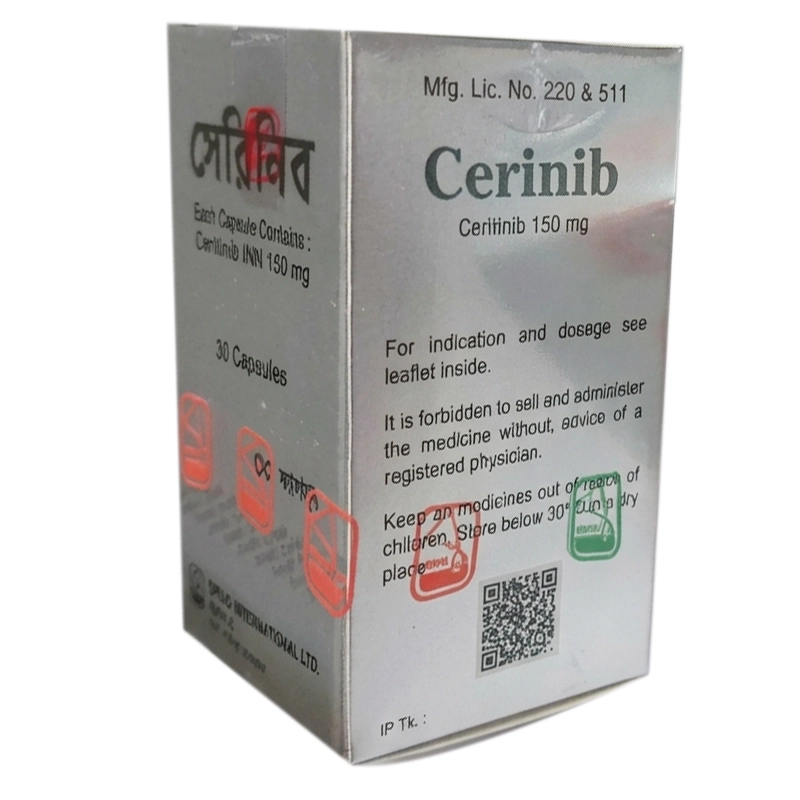
Ceritinib (Cerinib) 150mg Capsule
- Used for: Ceritinib is approved for adults with metastatic non-small cell lung cancer whose tumors are ALK-positive.
- Availability: In Stock
- Shipping: Express Global Shipping (7-14 days depending on region).
- Requirement: Valid prescription from a licensed healthcare provider required.
✓ WHO GMP Certified
✓ Reviewed By Medical Expert
✓ Batch Examined in Lab
Need Patient Access Support?
Our team provides verified global sourcing assistance to help you navigate international shipping and prescription requirements safely.
What Is Ceritinib (Cerinib)?
Ceritinib is a targeted cancer medicine. Cerinib is the brand name Drug International Ltd. uses for its ceritinib capsule. The company makes it in Bangladesh at a factory with WHO-GMP certification, a manufacturing standard set by the World Health Organization.
Ceritinib treats one kind of lung cancer: metastatic non-small cell lung cancer (NSCLC) in adults whose tumors carry a change in the ALK gene. This is called ALK-positive NSCLC. A lab test on the tumor shows whether the change is present. Ceritinib is not used for lung cancers without this change.
Each Cerinib capsule contains 150mg of ceritinib. Cerinib is sold as a capsule only. The labeled daily dose is 450mg, which is three capsules taken once a day with food. Your oncologist sets the dose that fits your treatment plan.
How Cerinib Relates to Zykadia
Zykadia is the original brand of ceritinib. Novartis makes it and it is approved by the US FDA. Novartis sells the same drug as Spexib in India. People often look for a Zykadia alternative because of price or because it is not sold in their country. Cerinib is a different manufacturer’s ceritinib. It contains the same active ingredient. It is made in a different country, under different regulatory oversight. Cerinib does not carry FDA approval. Drug International has not yet supplied bioequivalence data comparing Cerinib with Zykadia, so this page does not claim the two
products behave identically. If you already take Zykadia or another ceritinib brand, do not switch to Cerinib on your own. Ask your oncologist first.
| Feature | Cerinib (Drug International, Bangladesh) | Zykadia (Novartis) |
| Active ingredient | Ceritinib | Ceritinib |
| Forms | 150mg capsule | 150mg capsule and 150mg film-coated tablet (US label) |
| Manufacturing standard | WHO-GMP certified facility | FDA-approved product |
| Labeled dose in product information | 450mg once daily with food | 450mg once daily with food |
| Where it is available | Bangladesh; international access through Named Patient Programs | Sold by Novartis in many countries, under the name Spexib in India |
| Bioequivalence data | Not yet supplied by manufacturer (see Manufacturing and Quality below) | Original product |
Where Ceritinib Fits Among ALK Inhibitors
Several ALK inhibitors exist. The ASCO living guideline (version 2026.3) recommends alectinib, brigatinib, or lorlatinib as the first treatment for ALK-positive NSCLC. It states that ceritinib or crizotinib may be offered if those three are not available.
No randomized trial has compared ceritinib directly with alectinib, brigatinib, or lorlatinib. Ceritinib has trial data against chemotherapy, and it is approved for ALK-positive metastatic NSCLC. Access and cost can decide which ALK inhibitor a patient can actually receive, and that is where ceritinib may be relevant. Your oncologist decides which drug fits your cancer, your earlier treatments, and your situation.
If the cancer grows during treatment, guidelines advise repeat molecular testing. Resistance changes in the tumor can guide the choice of the next ALK inhibitor.
If you are comparing options, see our pages on Alecnib (alectinib) and Alkixen (crizotinib), two other ALK inhibitors.
Clinical Uses and Safety Management
Approved Use
Ceritinib is approved for adults with metastatic non-small cell lung cancer whose tumors are ALK-positive. The ALK status must be confirmed by a validated laboratory test on tumor tissue before treatment. It has no other approved indication.
Use in Children and Older Adults
The safety and effectiveness of ceritinib in children have not been established. In the label’s safety data, 18% of patients were 65 or older and 5% were 75 or older. No important differences in safety or effect were seen in older patients.
How Ceritinib Works
Some lung cancers are driven by an abnormal ALK protein. This protein sends constant signals that tell cancer cells to grow and divide. Ceritinib blocks the ALK protein. Without those signals, the cancer cells slow down and die.
In laboratory tests, ceritinib also blocked a few related proteins, including IGF-1R, the insulin receptor, and ROS1. Its strongest action is against ALK, and ALK-positive NSCLC is its only approved use.
How the Body Processes Ceritinib (Pharmacokinetics)
| Process | What Happens |
| Absorption | Blood levels peak about 4 to 6 hours after a dose. Food raises absorption. For the capsule, a high-fat meal raised total exposure (AUC) by 73%, and a low-fat meal raised it by 58%. This is why the current dose is taken with food. |
| Distribution | 97% of the drug binds to proteins in the blood. |
| Metabolism | The liver breaks down ceritinib. An enzyme called CYP3A does most of this work. |
| Excretion | About 92% leaves the body in stool, and 68% of the dose leaves unchanged. Only about 1.3% leaves in urine. |
| Half-life | About 41 hours. This supports once-a-day dosing. |
Dosing: 450mg With Food
The labeled dose is 450mg once a day with food. That is three 150mg capsules. Treatment continues until the cancer grows or side effects become unacceptable. Your oncologist sets your exact dose.
Why the food instruction matters. The first ceritinib studies used 750mg once a day on an empty stomach. A later study, ASCEND-8, compared that with 450mg taken with food. Blood levels were comparable, and the lower dose with food caused fewer stomach side effects. The label now recommends 450mg with food. Some older references and prescriptions still describe the earlier 750mg regimen. If your prescription differs from what this page describes, ask your oncologist which one applies to you.
Dose Changes
- First reduction: 300mg once a day with food (two capsules).
- Second reduction: 150mg once a day with food (one capsule).
- If 150mg is not tolerated: treatment stops.
- Severe liver impairment (Child-Pugh C): the dose is reduced by about one-third, rounded to the nearest 150mg. From 450mg, that is 300mg.
- Mild or moderate liver impairment, and any level of kidney impairment: no dose change is required by the label.
The 150mg capsule covers every step above, so one strength is enough for the full dose ladder.
Missed Doses and Vomiting
If you miss a dose, take it as soon as you remember, unless your next dose is due within 12 hours. In that case, skip the missed dose. If you vomit after a dose, do not take an extra dose. Take your next dose at the usual time. Tell your care team if you are missing doses or vomiting often, because both can affect how well treatment works.
How Many Capsules You Need
| Daily dose | Capsules per day | Capsules per 30 days | Boxes per 30 days (30 capsules each) |
| 450mg (labeled dose) | 3 | 90 | 3 |
| 300mg (first reduction) | 2 | 60 | 2 |
| 150mg (second reduction) | 1 | 30 | 1 |
Side Effects and the Dose You Take
Stomach side effects are the most common problem with ceritinib. They depend heavily on the dose schedule, so the table below names the dose behind each figure.
| Measure | 750mg on an empty stomach (older dose) | 450mg with food (current label dose) |
| Diarrhea, nausea, vomiting, or stomach pain (any grade) | 95% of 925 patients | 79% of 108 patients |
| Severe (Grade 3 to 4) stomach side effects | 14% of patients | 2 of 108 patients (1.9%): one with severe diarrhea and one with severe vomiting |
| Most common side effects (25% or more) | Diarrhea, nausea, vomiting, fatigue, stomach pain, decreased appetite, weight loss | Diarrhea, nausea, stomach pain, vomiting, fatigue |
At 450mg with food, 24% of patients in ASCEND-8 needed at least one dose reduction because of side effects, and 56% needed at least one pause. Your care team manages stomach side effects with anti-diarrhea medicine, anti-nausea medicine, or fluids as needed. Dose adjustments are a normal part of managing this medicine.
Other Common Side Effects and Lab Changes
The table below comes from ASCEND-4, in which 189 people took ceritinib at the older 750mg dose on an empty stomach. Rates at 450mg with food may differ, especially for stomach side effects.
| Finding | Any grade | Severe (Grade 3 to 4) |
| Diarrhea | 85% | 4.8% |
| Nausea | 69% | 2.6% |
| Vomiting | 67% | 5% |
| Fatigue | 45% | 7% |
| Stomach pain | 40% | 3.7% |
| Decreased appetite | 34% | 1.1% |
| Weight loss | 24% | 3.7% |
| Rash | 21% | 1.1% |
| Constipation | 20% | 0% |
| Raised ALT (liver enzyme, blood test) | 91% | 34% |
| Raised AST (liver enzyme, blood test) | 86% | 21% |
| High blood sugar (blood test) | 53% | 10% |
| Raised amylase (blood test) | 37% | 8% |
| Raised lipase (blood test) | 13% | 6% |
| Raised creatinine (blood test) | 77% | 4.2% |
| Raised bilirubin (blood test) | 15% | 0.5% |
Liver enzyme rises were the most frequent lab change. This is one reason liver blood tests are done every month.
Serious Warnings and Monitoring
Ceritinib does not carry a boxed warning on the US label. It does carry several serious warnings, listed below. The figures come from the label’s pooled safety data of 925 patients treated at the older 750mg dose on an empty stomach, unless stated.
| Risk | How often it occurred | What your care team does |
| Liver injury | ALT above 5 times the upper limit of normal in 28%. AST above 5 times in 16%. ALT above 3 times with bilirubin above 2 times in 0.3%. | Liver blood tests every month. Treatment is paused and restarted at a lower dose for ALT or AST above 5 times normal. It is stopped permanently if ALT or AST is above 3 times normal together with bilirubin above 2 times normal. |
| Lung inflammation (ILD or pneumonitis) | 2.4%. Severe in 1.3%. Fatal in 0.2%. | Report new or worsening cough, shortness of breath, or fever right away. Treatment is stopped permanently if it is confirmed. |
| Heart rhythm change (QT prolongation) | QTc rose by more than 60 msec in 6% of 919 patients. QTc rose above 500 msec in 1.3%. | ECG and blood salts (electrolytes) checked before treatment and periodically. Treatment is paused if QTc stays above 500 msec on two ECGs. Avoid it in congenital long QT syndrome. |
| High blood sugar | Severe (Grade 3 to 4) in 13%. | Fasting blood sugar checked before treatment and periodically. Treatment is paused if sugar stays above 250 mg/dL, then restarted at a lower dose once controlled. |
| Slow heart rate (bradycardia) | Heart rate under 50 beats per minute found in 1.1%. Reported as a side effect in 1%. | Heart rate and blood pressure checked. Other medicines that slow the heart are reviewed. Treatment is paused for symptomatic slowing until the rate recovers. |
| Pancreatitis and pancreatic enzymes | Pancreatitis in under 1%. Severe lipase rise in 14%. Severe amylase rise in 7%. | Lipase and amylase blood tests. Treatment may be paused or the dose lowered. |
| Sun sensitivity (photosensitivity) | Reported in 1.1% of patients in the label’s safety data. | Avoid long sun exposure. Use sunscreen and protective clothing. |
Call your oncology team promptly for yellowing of the skin or eyes, dark urine, severe stomach pain, new breathing problems, fainting or a racing or very slow heartbeat, or extreme thirst and frequent urination.
Drug Interactions
| Interacting Drug or Food | Effect | What to Do |
| Strong CYP3A inhibitors (for example, ketoconazole) | Raise ceritinib exposure about 2.9-fold. | Avoid if possible. If unavoidable, the ceritinib dose is reduced by about one-third. |
| Strong CYP3A inducers (for example, rifampin) | Lower ceritinib exposure by about 70%. | Avoid combining them. |
| Grapefruit and grapefruit juice | Can raise ceritinib levels by blocking CYP3A. | Do not eat grapefruit or drink grapefruit juice during treatment. |
| Sensitive CYP3A substrate drugs (for example, midazolam) | Ceritinib raised midazolam exposure about 5.4-fold. | The label advises avoiding this combination. If it cannot be avoided, the other drug’s dose may be lowered. |
| Warfarin and other CYP2C9 substrate drugs | Ceritinib raised exposure to S-warfarin by about 54%, which can increase bleeding risk. | Tell your oncologist if you take warfarin. Your team checks your INR more often. The label advises avoiding CYP2C9 drugs for which a small change in blood level could cause serious harm. |
| Acid-reducing medicines (proton pump inhibitors such as esomeprazole) | A single 750mg dose on an empty stomach gave 76% lower exposure in healthy volunteers, and 30% lower in a group of patients. The label reports no clinically meaningful effect at steady state and gives no instruction to avoid them. | Tell your oncologist about any antacid or acid-reducing medicine you take. |
| Other drugs that prolong the QT interval or slow the heart | Can add to heart rhythm risk. | Avoid when possible. Tell your oncologist about every medicine you take, including herbal products. |
Clinical Evidence Behind This Use
ASCEND-4 (first treatment). This phase 3 trial enrolled 376 people with ALK-positive NSCLC who had not been treated before. Half took ceritinib (750mg on an empty stomach) and half received platinum and pemetrexed chemotherapy. The cancer took a median of 16.6 months to grow or spread on ceritinib, compared with 8.1 months on chemotherapy (hazard ratio 0.55, 95% CI 0.42 to 0.73). A blinded independent review found that tumors responded in about 73% of people on ceritinib, compared with about 27% on chemotherapy. Among people with measurable brain metastases (28 on ceritinib and 27 on chemotherapy), 57% responded on ceritinib and 22% on chemotherapy. At the planned interim analysis, overall survival did not differ significantly between the groups.
ASCEND-5 (after earlier treatment). This trial enrolled 231 people whose cancer had grown after chemotherapy and crizotinib. Ceritinib (750mg on an empty stomach) delayed progression to a median of 5.4 months, compared with 1.6 months on chemotherapy (hazard ratio 0.49, 95% CI 0.36 to 0.67).
ASCEND-8 (dose study). This trial compared 450mg with food (108 patients) against 750mg on an empty stomach (110 patients). Drug exposure was comparable, and stomach side effects were milder at 450mg with food. This study is the basis for the current label dose.
These trials were run before alectinib, brigatinib, and lorlatinib became preferred first treatments. The results show that ceritinib works better than chemotherapy in ALK-positive NSCLC. The trials did not test ceritinib against the newer ALK inhibitors.
Administration and Handling
- How to take it: Take Cerinib once a day, at about the same time each day, with food. Do not take it on an empty stomach, because the labeled dose was set for use with food.
- Grapefruit: Avoid grapefruit and grapefruit juice for the whole course of treatment.
- Sun protection: Ceritinib can make skin more sensitive to sunlight. Avoid long sun exposure. Use sunscreen and protective clothing.
- Home use: Cerinib is an oral capsule. Your oncologist still needs to review your blood tests, ECG, and symptoms on a regular schedule.
- Missed dose or vomiting: See the instructions above. Do not double up.
Storage
Store Cerinib as directed on its packaging. For reference, the US Zykadia label states 20°C to 25°C (68°F to 77°F), with short excursions between 15°C and 30°C (59°F and 86°F) allowed. Keep capsules out of the reach of children.
Pregnancy, Breastfeeding, and Contraception
- Ceritinib can harm an unborn baby. Pregnancy status should be checked before treatment starts.
- Female patients who can become pregnant need effective contraception during treatment and for 6 months after the last dose.
- Male patients with female partners who can become pregnant should use condoms during treatment and for 3 months after the last dose, because ceritinib may damage genes.
- Do not breastfeed during treatment and for 2 weeks after the last dose.
Kidney and Liver Function
No dose change is required for kidney impairment. For the liver, no change is required for mild or moderate impairment, and the dose is reduced by about one-third for severe impairment (see the dose changes above). In severe liver impairment, drug exposure was about 66% higher. Because ceritinib can itself injure the liver, your team checks liver blood tests every month whatever your baseline liver function.
Manufacturing and Quality
Drug International Ltd. makes Cerinib at a WHO-GMP certified facility in Bangladesh. WHO-GMP certification means the factory follows World Health Organization manufacturing standards.
WHO-GMP certification applies to the factory. FDA approval is a US regulatory decision about a specific product. Drug International’s Cerinib does not carry FDA approval.
Drug International has not yet supplied comparative dissolution or bioequivalence data for Cerinib. We will add a bioequivalence statement once that data is available. Until then, this page states plainly that the data has not been provided.
Global Access to Ceritinib Through a Named Patient Program (NPP)
Cerinib may not be sold where you live, or it may be hard to obtain there. If so, you may be able to access it through a Named Patient Program. This is a legal pathway. It lets one named patient import a medicine prescribed by their own doctor, even if that exact product is not sold in their country.
You will typically need:
- A valid prescription from your treating oncologist
- A Letter of Medical Necessity (LMN)
- Patient identification
- A report confirming your tumor is ALK-positive
- An import license or no-objection certificate (NOC), if your country requires one
Cerinib is an oral capsule, so it ships and clears customs like most oral medicines. Because a 30-day supply at the labeled dose is 90 capsules, we quote by monthly supply so you can plan your treatment. Ceritinib also needs monthly liver blood tests and periodic ECGs, so confirm with your oncologist that these can be arranged where you live. Our team will tell you upfront which requirements apply to your country.
What is the generic name for Cerinib?
The generic name is ceritinib. Cerinib is the brand name Drug International Ltd. uses for its ceritinib capsule.
Is Cerinib a generic Zykadia?
Cerinib contains the same active ingredient as Zykadia, which is ceritinib. Novartis makes Zykadia. Drug International makes Cerinib. Drug International has not yet supplied bioequivalence data comparing the two, so we do not state that they behave identically.
Can I switch from Zykadia to Cerinib?
Speak to your oncologist before switching. Drug International has not yet supplied bioequivalence data comparing Cerinib with Zykadia, so we cannot say the two behave identically. Do not change brands on your own.
Is Cerinib FDA approved?
No. Cerinib is made at a WHO-GMP certified factory in Bangladesh. FDA approval applies to specific products, and Cerinib does not hold it. Zykadia, made by Novartis, is the FDA-approved ceritinib product.
Who manufactures the Cerinib sold through Generic Oncology?
Drug International Ltd. manufactures it. This is a pharmaceutical company based in Bangladesh, with a WHO-GMP certified facility.
What is ceritinib used to treat?
Ceritinib is approved for adults with metastatic non-small cell lung cancer whose tumors are ALK-positive. A lab test must confirm the ALK change before treatment.
How many Cerinib capsules do I take, and how long does a box last?
The labeled dose is 450mg once a day, which is three 150mg capsules. A box holds 30 capsules, so one box lasts 10 days at that dose. A 30-day supply is 90 capsules, or 3 boxes. If your doctor lowers your dose, a box lasts longer.
Should I take Cerinib with food?
Yes. The current labeled dose is 450mg once a day with food. Older references describe 750mg on an empty stomach, which caused more stomach side effects. Ask your oncologist which dose applies to you.
What if I miss a dose or vomit after taking Cerinib?
If you miss a dose, take it when you remember, unless your next dose is due within 12 hours. Then skip the missed dose. If you vomit after a dose, do not take another one. Take your next dose at the usual time.
What are the most common side effects of ceritinib?
The most common side effects are diarrhea, nausea, stomach pain, vomiting, and fatigue. Ceritinib can also affect the liver, lungs, heart rhythm, blood sugar, and pancreas, and it can make skin more sensitive to sunlight. Your care team checks blood tests and an ECG on a regular schedule.
Can I eat grapefruit or take acid-reducing medicine with ceritinib?
Avoid grapefruit and grapefruit juice. Acid-reducing medicines such as proton pump inhibitors can lower ceritinib exposure after a single dose, but the label reports no clinically meaningful effect at steady state. Tell your oncologist about every medicine you take.
Do I need contraception during ceritinib treatment?
Yes, for both partners. Females who can become pregnant need effective contraception during treatment and for 6 months after the last dose. Males with female partners should use condoms during treatment and for 3 months after.
Is ceritinib the first choice for ALK-positive lung cancer?
Usually not. Current ASCO guidance recommends alectinib, brigatinib, or lorlatinib first, and lists ceritinib for when those are not available. Ceritinib has trial data against chemotherapy but has not been compared directly with the newer drugs. Your oncologist decides which drug fits you.
Related products

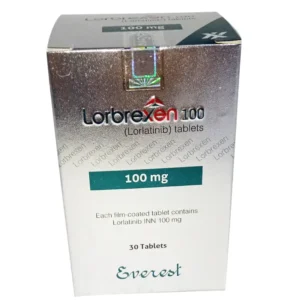
Lorbrexen 100 mg Tablet (Lorlatinib)
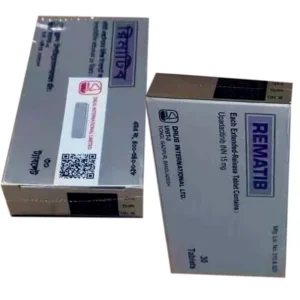
Request PriceRematib 15 mg (Upadacitinib) | Selective Janus Kinase 1 (JAK1) Inhibitor
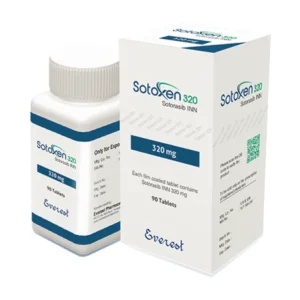
Request PriceSotoxen 120 mg (Sotorasib) 56 Tablets | Price, Uses, Patient Safety, & Access Guide
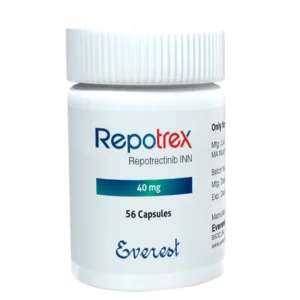
Request PriceRepotrex 40 mg (Reptorectinib) 56 Capsules | Price & Access Guide
Request Price