Sourcing Disclosure: Licensed Bangladesh Global Sourcing Specialist facilitating global access under Named Patient Regulations.
Expert-reviewed clinical data for prescription-only medicine.


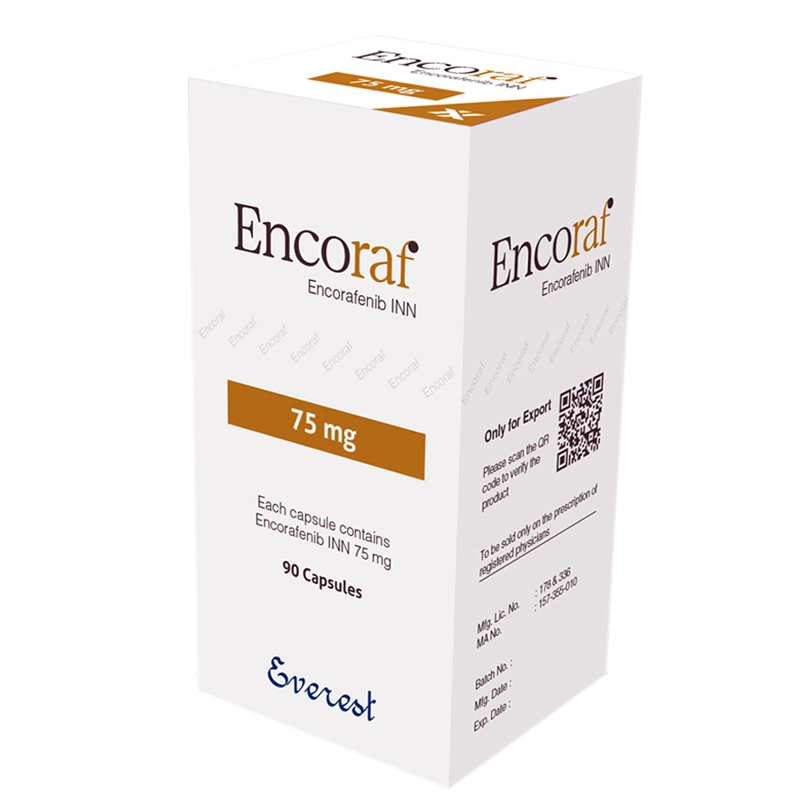
Encoraf (Encorafenib 75 mg) Capsule | BRAF Kinase Inhibitor
Author: Salma Abdel
Brand name: Encoraf
Generic Name: Encorafenib
Therapeutic Class: BRAF Kinase Inhibitor
Clinical Indication: BRAF V600E/K-mutated Melanoma, Colorectal Cancer (CRC), and Non-Small Cell Lung Cancer (NSCLC)
Available strength: 75 mg
Pack size: 42 Capsules
- WHO GMP Certified
- Reviewed By Medical Expert
- Batch Examined in Lab
Medically Reviewed by Dr. Salma Elreedy, MD (Clinical Oncology)
Last Updated: March 10, 2026
Classification: Prescription-Only Medicine (POM)
Prescription-Only Notice: This medication requires a valid prescription, confirmed biomarker testing, and rigorous clinical monitoring due to its specific molecular targeting and side effect profile.
Encoraf (encorafenib 75 mg) is an oral prescription medication classified as a small-molecule BRAF kinase inhibitor. It is the generic to the innovator brand BRAFTOVI. In clinical oncology, encorafenib is deployed to treat specific aggressive cancers that are driven by a genetic mutation in the BRAF gene. It is rarely used as a standalone treatment; rather, it is prescribed in combination with other targeted therapies—such as a MEK inhibitor (binimetinib) or an EGFR inhibitor (cetuximab)—to shut down cancer cell proliferation across multiple pathways and prevent rapid treatment resistance.
Oncologist’s Guidance to Clinical Use
Who exactly is a candidate for Encoraf therapy?
According to the FDA data, this medication is strictly for patients whose tumor biopsy confirms the presence of a specific genetic mutation. You are a candidate if you meet one of the following criteria:
Metastatic Melanoma: You have unresectable or metastatic melanoma with a confirmed BRAF V600E or BRAF V600K mutation. It is prescribed in combination with binimetinib.
Colorectal Cancer (CRC): You have metastatic colorectal cancer with a BRAF V600E mutation and have already received prior systemic therapy. It is prescribed in combination with cetuximab.
Non-Small Cell Lung Cancer (NSCLC): You have metastatic NSCLC with a BRAF V600E mutation. It is prescribed in combination with binimetinib.
How does this medication work at the cellular level?
To understand encorafenib, we look at the MAPK signaling pathway (specifically the RAS-RAF-MEK-ERK chain). This pathway regulates how cells grow and divide.
In a healthy cell, the BRAF protein acts as a switch, turning on only when instructed. In a cancer cell with a BRAF V600 mutation, the switch is permanently stuck in the “on” position, causing uncontrolled tumor growth. Encorafenib specifically seeks out and binds to this mutated BRAF protein, turning off the hyperactive signal and inducing cell death.
What is the standard dosage and administration protocol?
The dosage depends entirely on your specific cancer diagnosis:
For Melanoma and NSCLC: The recommended dose is 450 mg taken once daily (in combination with binimetinib). Since Encoraf comes in 75 mg capsules, this requires taking six (6) capsules together at the same time each day.
For Colorectal Cancer (CRC): The recommended dose is 300 mg taken once daily (in combination with cetuximab). This requires taking four (4) capsules once a day.
Administration: You can take the capsules with or without food. Do not open, crush, or chew them.
Missed Doses: If you miss a dose and your next scheduled dose is more than 12 hours away, take it as soon as you remember. If it is less than 12 hours until your next dose, skip it entirely. Do not double your dose.
What are the primary safety concerns and side effects?
Because this drug manipulates cell signaling, it requires active management:
New Primary Malignancies: Paradoxically, inhibiting BRAF can stimulate cell growth in tissues that do not have the mutation, leading to skin cancers like Cutaneous Squamous Cell Carcinoma (cuSCC).
Actionable Advice: You will undergo a full dermatological exam prior to treatment, every 2 months during treatment, and for up to 6 months after discontinuing the drug.
Cardiac Toxicity (QTc Prolongation): The medication can alter your heart’s electrical cycle.
Actionable Advice: We will monitor your electrolytes and perform regular Electrocardiograms (ECGs) to ensure your heart rhythm remains stable.
Ocular Toxicities: Uveitis, iritis, and iridocyclitis can occur.
Actionable Advice: Report any eye pain, redness, or visual changes to your care team immediately for an ophthalmology referral.
Common Daily Side Effects: Nausea, fatigue, joint pain (arthralgia), and vomiting.
Actionable Advice: Stay aggressively hydrated. We can prescribe antiemetics (anti-nausea medications) to be taken 30 minutes prior to your daily Encoraf dose to maintain your quality of life.
What does the clinical trial data show regarding efficacy?
The standard of care utilizing encorafenib is supported by landmark phase III trials:
The COLUMBUS Trial (Melanoma): Published in The Lancet Oncology, this trial demonstrated that patients taking encorafenib plus binimetinib achieved a median Progression-Free Survival (PFS) of 14.9 months, compared to 7.3 months for vemurafenib monotherapy. The Overall Response Rate (ORR) was 64%.
The BEACON Trial (Colorectal Cancer): Published in The New England Journal of Medicine, this study revolutionized CRC treatment. Patients with previously treated BRAF V600E-mutant CRC receiving encorafenib plus cetuximab achieved a median Overall Survival (OS) of 8.4 months, significantly outperforming standard chemotherapy regimens.
The PHAROS Trial (NSCLC): Published in the Journal of Clinical Oncology, this trial showed an ORR of 75% in treatment-naive patients and 46% in previously treated patients receiving the encorafenib and binimetinib combination.
Precautions & Special Populations
Hepatic Impairment: Encorafenib is metabolized by the liver. While mild hepatic impairment does not require a dose adjustment, patients with moderate or severe hepatic impairment will require a reduced dosage (e.g., 300 mg or 225 mg daily) and stringent liver enzyme (ALT/AST) monitoring.
Pregnancy and Lactation: Encorafenib exhibits severe embryo-fetal toxicity. Female patients of reproductive potential must use highly effective, non-hormonal contraception during therapy and for at least 2 weeks after the final dose. Breastfeeding is contraindicated during treatment and for 2 weeks following the last dose.
Storage Logistics: Store the capsules at standard room temperature (20°C to 25°C). Cold-chain refrigeration is not required. Keep the desiccant inside the bottle and store it in a dry environment to prevent moisture degradation.
Manufacturer Trust & Global Access
Manufacturer Quality Assurance: Encoraf is manufactured in Bangladesh by Everest Pharmaceuticals. The facility operates under strict WHO-GMP (World Health Organization – Good Manufacturing Practices) compliance. Every production batch undergoes rigorous comparative dissolution and stability profiling to ensure strict WHO GMP standards to the innovator product (BRAFTOVI). This guarantees that the Active Pharmaceutical Ingredient (API) delivers identical therapeutic exposure and safety profiles as the original drug.
Global Supply Chain: Targeted therapies are often inaccessible or delayed in various global markets. Encoraf can be accessed by international patients through established global distribution channels operating strictly on a “Named Patient” or personal importation basis. This legal mechanism allows patients with a verified specialist prescription to import the medication for personal use when it is locally unavailable. Orders are shipped utilizing temperature-controlled logistics to guarantee the medication’s structural integrity from the manufacturer to the patient.
People Also Ask
Why do I have to take Encoraf with another medication like binimetinib or cetuximab?
Cancer cells are highly adaptive. If we block the BRAF protein using Encoraf alone (monotherapy), the cancer quickly finds a “bypass” route to continue growing, which can also trigger severe skin toxicities. By adding a second inhibitor, we block the main road and the bypass route simultaneously, which delays resistance and shrinks the tumor much more effectively.
Are there dietary restrictions while taking Encorafenib?
Yes. You must strictly avoid consuming grapefruit, grapefruit juice, or Seville oranges while on this medication. These foods inhibit the CYP3A4 enzyme in your liver, which is responsible for breaking down encorafenib. Consuming them can lead to dangerously high, toxic levels of the drug in your bloodstream.
Can I take my regular over-the-counter medications with this?
You must consult your oncologist or clinical pharmacist before taking any new medication, including herbal supplements. Encorafenib interacts significantly with drugs that prolong the QT interval (certain antibiotics and antidepressants) and is severely impacted by strong CYP3A4 inducers (like St. John’s Wort) and inhibitors (like ketoconazole).
Related products

Binixen 15 mg Tablets (Binimetinib) | MEK Inhibitor
Consult Pharmacist for PriceVelpanex (Sofosbuvir + Velpatasvir) 100 mg + 400 mg | HCV Direct Acting Antiviral
Consult Pharmacist for PriceRepotrex 40 mg Capsule (Reptorectinib) | ROS1-positive & NTRK gene fusion-positive Therapy
Consult Pharmacist for PriceNiranib 100 mg Capsule (Niraparib) | Clinical Profile and Treatment Overview
Consult Pharmacist for Price


Reviews
There are no reviews yet.