Prescription required. We facilitate access to medicines already prescribed by your treating physician. We do not provide medical advice or diagnoses.


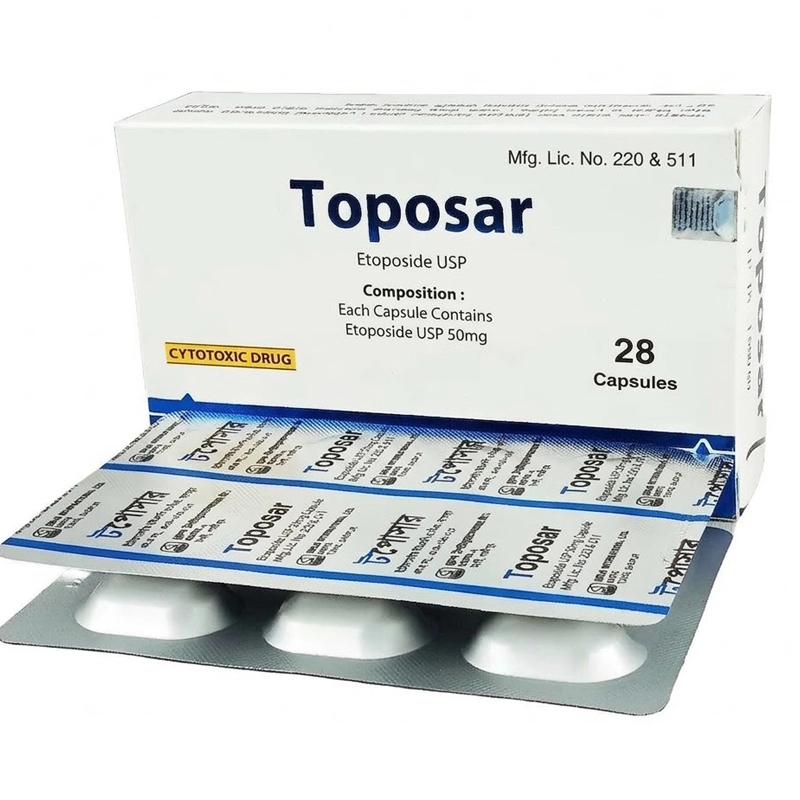
Toposar (Etoposide) 50mg Capsule & 100mg/5mL Injection
Request PriceWhat Is Toposar (Etoposide)?
Toposar is a brand name for etoposide. Drug International Ltd. makes it in Bangladesh. The factory holds WHO-GMP certification, a manufacturing standard set by the World Health Organization.
Etoposide is a chemotherapy drug. Doctors have used it for more than 40 years. It is most often used for small cell lung cancer and testicular cancer, usually together with other chemotherapy drugs.
Toposar comes in two forms. One is a 50mg capsule you swallow. The other is a 100mg/5mL liquid given through a vein (IV) in a hospital or clinic. Your oncologist chooses the form and dose that fit your treatment plan.
“Etoposide has a decades-long track record in small cell lung cancer and testicular cancer, so we know how to use it and manage its risks well. What’s changed more recently is access: patients in many countries now reach WHO-GMP-manufactured versions like this one through Named Patient Programs, which matters when the originally available product isn’t sold or affordable where they live.”
— Salma Mamdouh Elreedy, Clinical Oncologist, Sphinx Cure Oncology Center
Important: Two Different “Toposar” Products Exist
The brand name Toposar is also used in the United States. There, it names an etoposide injection made by Teva Parenteral Medicines, under FDA application number ANDA074529.
This is a different manufacturer’s product. It is made in a different country, under different regulatory oversight, from the Toposar described on this page. Both products share the same active ingredient: etoposide. But they are not the same manufactured product. Everything on this page describes Drug International’s Bangladesh-manufactured Toposar.
| Feature | Toposar (Drug International, Bangladesh) | Toposar (Teva Parenteral Medicines, USA) |
|---|---|---|
| Active ingredient | Etoposide | Etoposide |
| Forms | 50mg capsule; 100mg/5mL injection | Injection (various vial sizes) |
| Manufacturing standard | WHO-GMP certified facility | FDA-approved (ANDA074529) |
| Where it’s available | Bangladesh; international access through Named Patient Programs | United States, through the US prescription drug supply chain |
| Bioequivalence data | Not yet supplied by manufacturer (see Manufacturing and Quality section below) | Established through the FDA’s ANDA approval process |
Clinical Uses and Safety Management
Approved Uses
Etoposide is approved for these uses:
- Small cell lung cancer (SCLC): Given with a platinum drug, either cisplatin or carboplatin. Used as a first treatment. Sometimes used again if the cancer returns.
- Testicular cancer: Used as a first treatment. Also used if earlier chemotherapy did not work. Covers both seminoma and non-seminoma types.
- AIDS-related Kaposi’s sarcoma: Used as a second treatment option to ease symptoms.
Doctors also prescribe etoposide for other cancers, based on cancer treatment guidelines rather than a specific approval for that cancer. This is normal practice for an older chemotherapy drug: etoposide has been a standard part of many treatment combinations for decades, and guidelines reflect that accumulated experience even where a formal approval was never filed for every use. These guideline-supported, off-label uses include Hodgkin and non-Hodgkin lymphoma, acute myeloid leukemia, acute lymphoblastic leukemia, neuroblastoma, Wilms’ tumor, and ovarian germ cell tumors. If your doctor prescribes Toposar for one of these, ask them to explain why. This is normal practice, but you should understand your specific treatment goal.
Use in Children
Some of the guideline-supported uses above, including neuroblastoma and Wilms’ tumor, are cancers that occur in children. However, the safety and effectiveness of etoposide have not been systematically studied in children, and clinical experience in childhood cancers is limited compared with adult use. If a child is prescribed Toposar, this should happen only under the direct care of a pediatric oncologist, who can weigh the limited pediatric data against your child’s specific situation.
How Etoposide Works
Etoposide blocks an enzyme called topoisomerase II. Cells use this enzyme to unwind and repair their own DNA. They need it right before they divide into two new cells.
Without this enzyme working properly, DNA strands break apart. The breaks do not repair correctly. Cancer cells cannot finish dividing, so they die.
Etoposide mainly affects cells in two specific phases of their life cycle: late S phase and G2 phase. These are the stages just before a cell splits in two.
How the Body Processes Etoposide (Pharmacokinetics)
| Process | What Happens |
|---|---|
| Absorption | The capsule is absorbed at about 50% on average. This can range from 25% to 75% between patients. Blood levels can vary from person to person. |
| Distribution | 97% of the drug binds to proteins in the blood. Very little reaches the brain and spinal fluid. |
| Metabolism | The liver breaks down etoposide. An enzyme called CYP3A4 does most of this work. |
| Excretion | About 45% to 56% leaves the body through urine. Roughly 44% leaves through bile and stool. |
| Half-life | 4 to 11 hours. This is why doses are usually given over several days, not as one single dose. |
Dosing and Managing Side Effects
The ranges below are typical starting points, not a fixed rule. Your oncologist sets your exact dose. This depends on your body size, blood counts, kidney function, and overall treatment plan.
- Small cell lung cancer: 35 mg/m² per day for 4 days. Or 50 mg/m² per day for 5 days. Repeated every 3 to 4 weeks.
- Testicular cancer: 50 to 100 mg/m² per day on days 1 through 5. Or 100 mg/m² per day on days 1, 3, and 5. Repeated every 3 to 4 weeks.
- Switching from IV to capsules: The oral dose is about twice the IV dose, rounded to the nearest 50mg. This is because the body absorbs less of the oral dose.
- Reduced kidney function: If creatinine clearance is 15 to 50 mL/min, the dose is usually cut to 75%. Your doctor may lower it further if kidney function is worse.
If you miss a capsule dose: call your oncology team the same day for instructions. Do not double up on your next dose to make up for a missed one unless your doctor tells you to. Because your treatment schedule is planned around specific days, a missed dose can affect your whole cycle, so your care team needs to know right away, not at your next visit.
| Side Effect | Mild to Moderate (Grade 1–2) | Severe (Grade 3–4) |
|---|---|---|
| Low white blood cells (neutropenia/leukopenia) | Your care team monitors blood counts closely. Treatment can often continue on schedule. | The next dose may be delayed or lowered. Growth-factor support (G-CSF) may be added. Your team watches closely for fever or infection. |
| Low platelets (thrombocytopenia) | Platelet counts are checked before each treatment cycle. | Treatment is delayed until platelets recover. A platelet transfusion may be given if bleeding occurs. |
| Nausea and vomiting | Standard anti-nausea medicine is given before and after treatment. | A stronger anti-nausea combination is used. Your team checks for signs of dehydration. |
| Low blood pressure during infusion | The infusion rate is slowed. | The infusion is stopped. IV fluids are given. Vital signs are watched closely. |
Drug Interactions
| Interacting Drug or Situation | Effect | What to Do |
|---|---|---|
| High-dose cyclosporine | Can raise etoposide levels in the blood by about 80%. Can slow clearance by about 38%. | Your oncology team monitors closely and may adjust the dose. |
| Cisplatin | Can slow how quickly the body clears etoposide. | Already planned for in combination regimens. No action needed from you. |
| Warfarin and other blood thinners | Etoposide combinations have been reported to increase the blood-thinning effect, raising bleeding risk. | Tell your oncologist if you take warfarin or any other blood thinner. Your team may check your blood clotting levels more often. |
| Live vaccines | Chemotherapy weakens your immune system, so a live vaccine could cause an infection it would normally prevent. | Avoid live vaccines during treatment. Ask your oncologist when it is safe to resume them afterward. |
| Other chemotherapy or radiation | Can add to bone marrow suppression. | Blood counts are checked more often when drugs are combined. |
| Aspirin, sodium salicylate, phenylbutazone | At high doses, these can push etoposide off blood proteins. | Tell your oncologist about every medicine you take, including over-the-counter pain relievers. |
Clinical Evidence Behind These Uses
Etoposide plus a platinum drug (cisplatin or carboplatin) has been a standard first treatment for extensive-stage small cell lung cancer for decades, backed by a large body of clinical trial data. Current treatment guidelines now prefer adding an immunotherapy drug (atezolizumab or durvalumab) to platinum-etoposide as the first choice for this cancer. Platinum-etoposide alone remains a recommended option, including for patients who cannot receive immunotherapy.
In testicular cancer, etoposide is a core part of the BEP regimen. BEP stands for bleomycin, etoposide, and cisplatin. This regimen replaced an earlier combination that used vinblastine instead of etoposide, after research (with Dr. Lawrence Einhorn among the investigators) found it worked as well with fewer nerve-related side effects. Cisplatin-based combination chemotherapy, which Einhorn pioneered in the 1970s, changed testicular cancer from a disease that often killed patients into one of the most curable solid tumors in oncology. Under the IGCCCG risk classification, patients in the “good-risk” group now have cure rates above 90%.
Boxed Warning
| WARNING: Give this medicine only under the supervision of a doctor experienced in cancer chemotherapy. Etoposide can severely suppress bone marrow function. This can lead to serious infection or bleeding. Your care team checks your blood counts regularly during treatment. |
Secondary Cancer Risk (Long-Term)
Etoposide belongs to a class of drugs that can rarely cause a second cancer years after treatment, most often a form of acute leukemia. This has been reported in patients treated with etoposide together with other chemotherapy drugs, at a median of around 32 months after treatment. This risk is well documented but not fully predictable. It does not mean this will happen to you, and it is not a reason to avoid necessary chemotherapy on its own. Your oncologist weighs this small long-term risk against the risk of not treating your cancer, and can answer questions specific to your situation.
Administration and Handling
- IV infusion: Given slowly through a vein, over 30 to 60 minutes. Always given in a hospital or cancer clinic, under medical supervision. The IV form of Toposar is never meant for self-injection at home. Infusing it too quickly can cause a sudden drop in blood pressure (see the side effects table above), which is why the slow infusion rate matters.
- Extravasation: If the IV solution leaks into the skin around the vein, it can cause swelling. Rarely, it can cause tissue damage. Tell your nurse right away if you feel burning, stinging, or swelling at the injection site.
- Capsules: Taken by mouth, usually once a day. Take them with or without food, as your doctor directs. Swallow capsules whole. Do not open or crush them.
- Handling at home: Etoposide is a hazardous drug. Caregivers should wash their hands after contact with the patient’s body fluids. Follow your care team’s instructions for safe handling.
Storage
- Capsules: Store in a refrigerator, between 2°C and 8°C (36°F to 46°F). Do not freeze.
- IV vials (unopened): Store at room temperature, 20°C to 25°C (68°F to 77°F). Do not freeze.
Pregnancy, Breastfeeding, and Fertility
- Etoposide can harm an unborn baby. Animal studies have shown birth defects with this drug.
- Effective contraception is needed for both male and female patients during treatment and for 6 months after the last dose.
- Do not breastfeed while taking this medicine.
- Chemotherapy can affect fertility in both men and women. Talk to your oncologist about fertility preservation before you start treatment.
Kidney and Liver Function
Your doctor checks your kidney function before and during treatment. The dose is reduced if kidney function is reduced (see the dosing section above).
For liver function, available data suggests the body clears etoposide at a similar rate even when liver function is reduced, so no separate dose reduction formula exists for liver impairment. Your doctor still checks your liver function regularly during treatment and will stop treatment if it becomes abnormal.
Manufacturing and Quality
Drug International Ltd. makes Toposar at a WHO-GMP certified facility in Bangladesh. WHO-GMP certification means the factory follows World Health Organization manufacturing standards.
This is different from FDA approval. FDA approval is a US regulatory decision about one specific product. Drug International’s Toposar does not carry FDA approval. It is manufactured to WHO-GMP standards, for markets that recognize that certification.
Drug International has not yet supplied comparative dissolution or bioequivalence data for this product. We will add a bioequivalence statement once that data is available. Until then, we are stating plainly that this data has not been provided, rather than assuming it.
Global Access Through a Named Patient Program (NPP)
Toposar may not be sold or affordable where you live. If so, you may be able to access it through a Named Patient Program. This is a legal pathway. It lets one named patient import a medicine prescribed by their own doctor, even if that exact product isn’t sold in their country.
You will typically need:
- A valid prescription from your treating oncologist
- A Letter of Medical Necessity (LMN)
- Patient identification
- An import license or no-objection certificate (NOC), if your country requires one
The capsule and IV forms are not equally simple to import. The capsule ships and clears customs like most oral medicines. The IV form is a hazardous injectable drug, so some countries add extra requirements for it, such as cold-chain shipping or a licensed facility to receive it. Our team will tell you upfront which requirements apply to your country and the form you need.
Frequently Asked Questions
What is the generic name for Toposar?
The generic name for Toposar is etoposide. Toposar is simply a brand name. Drug International uses it for its etoposide product. Teva Parenteral Medicines separately uses the same brand name for its own etoposide product in the US.
Is Toposar the same as generic etoposide?
Yes. Toposar contains the same active ingredient as any other etoposide product: etoposide itself. Toposar is not a separate drug from “generic etoposide.” It is one manufacturer’s branded version of it.
Who manufactures the Toposar sold through Generic Oncology?
Drug International Ltd. manufactures it. This is a WHO-GMP certified pharmaceutical company based in Bangladesh. It is a different manufacturer from the FDA-approved Toposar sold in the United States. See the comparison table near the top of this page for the full picture.
What conditions is Toposar (Etoposide) used to treat?
Etoposide is approved for small cell lung cancer and testicular cancer. It is also used as a second treatment for AIDS-related Kaposi’s sarcoma. Doctors sometimes prescribe it off-label for other cancers, based on treatment guidelines. These include certain lymphomas and leukemias.
What forms does Toposar come in?
Toposar comes as a 50mg capsule you swallow, and as a 100mg/5mL solution given by IV infusion. Your oncologist decides which form fits your treatment plan.
What are the most common side effects of Toposar?
The most common side effects are low blood counts, nausea and vomiting, hair loss, and low appetite. Low blood counts can affect white blood cells, platelets, and red blood cells. Your oncology team checks your blood counts often during treatment to manage these effects.
Does Toposar carry a long-term cancer risk?
Rarely, yes. Etoposide is linked to a small risk of a second cancer, usually a form of leukemia, appearing years after treatment. This is a known, documented risk for this class of drug, not something specific to one brand or manufacturer. Your oncologist can explain how this risk compares with the benefit of treating your current cancer.
What if I miss a dose of Toposar capsules?
Call your oncology team the same day. Do not take an extra dose to make up for a missed one unless your doctor tells you to. Your treatment schedule is planned around specific days, so your care team needs to know about a missed dose right away.
How can international patients access Toposar?
International patients can access Toposar through a Named Patient Program. This means submitting a valid prescription along with the supporting documents listed above. Upload your prescription, or message us on WhatsApp. Our team will guide you through the process for your country.