Prescription required. We facilitate access to medicines already prescribed by your treating physician. We do not provide medical advice or diagnoses.


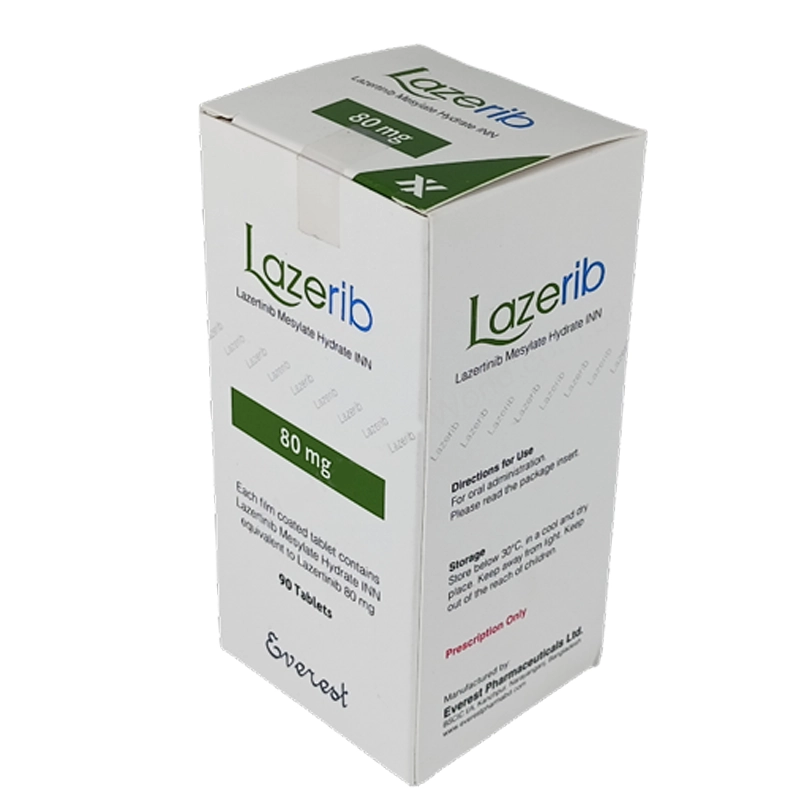
Lazerib 80 mg (Lazertinib) 90 Tablets: Lazcluze Alternative Price and Global Access Guide
Our team provides verified global sourcing assistance to help you navigate international shipping and prescription requirements safely.
✓ WHO GMP Certified
✓ Reviewed By Medical Expert
✓ Batch Examined in Lab
Need Patient Access Support?
Lazerib (containing 80 mg of lazertinib) is a highly selective, brain-penetrant, third-generation epidermal growth factor receptor (EGFR) tyrosine kinase inhibitor (TKI). It is specifically engineered to target both sensitizing EGFR mutations and the T790M resistance mutation while sparing wild-type EGFR. Lazerib is indicated for the first-line treatment of adult patients with locally advanced or metastatic non-small cell lung cancer (NSCLC) whose tumors have EGFR exon 19 deletions or exon 21 L858R substitution mutations, typically utilized in combination with amivantamab.
Medical Expert Commentary on Lazerib 80 mg
“In the earlier years of targeted oncology, whether we were managing advanced malignancies with early androgen receptor inhibitors or tackling lung cancer with first-generation TKIs, we faced a persistent, frustrating hurdle: the inevitable emergence of acquired resistance. The introduction of third-generation therapies like lazertinib marks a definitive paradigm shift. By definitively targeting specific exon mutations and penetrating the blood-brain barrier, we are suppressing the resistance pathways that previously curtailed survival.
In my clinical practice, the practical impact of improving patient access through high-quality generics cannot be overstated. For years, the high cost of innovator brands restricted optimal, first-line regimens. Now, with rigorously tested, bioequivalent options like Lazerib, I can confidently offer my patients a treatment that matches the innovator’s pharmacokinetic profile. This significantly reduces financial toxicity, ensuring that the clinical impact of advanced targeted therapy reaches the broader global population.” -Dr. Salma Elreedy
Clinical Uses & Safety Management Protocols
Precise Indications & Biomarker Necessity
Lazerib is strictly indicated for patients with laboratory-confirmed specific EGFR mutations.
- Indication: First-line treatment of locally advanced or metastatic NSCLC.
- Biomarker Requirement: EGFR exon 19 deletions (ex19del) or exon 21 L858R substitution mutations.
- Companion Diagnostics: Biomarker presence must be verified by an FDA-authorized or CE-IVD marked companion diagnostic test (e.g., cobas® EGFR Mutation Test v2) utilizing tumor tissue or circulating tumor DNA (ctDNA) plasma before initiating therapy.
Mechanism & Pharmacokinetics (ADME)
Lazertinib binds covalently to the kinase domain of mutant EGFR, irreversibly inhibiting its enzymatic activity and downstream signaling pathways.
- Absorption: The median time to maximum concentration (Tmax) is approximately 4 hours. Administration with food does not result in clinically significant changes to systemic exposure.
- Distribution: Lazertinib is highly bound to human plasma proteins (>99%). It is designed to be highly brain-penetrant, achieving clinically active concentrations in the central nervous system.
- Metabolism: Primarily metabolized in the liver by CYP3A4.
- Excretion: Primarily eliminated via feces (approximately 80%), with minor elimination in urine (less than 10%).
- Half-life (t1/2): The terminal elimination half-life is approximately 68 hours, supporting once-daily dosing.
Dosage & Adverse Event (AE) Management
Baseline Dosing: The recommended dose of Lazerib is 240 mg (three 80 mg tablets) administered orally once daily, in combination with amivantamab.
| Toxicity Category | Grade 1-2 Management | Grade 3-4 Management |
|---|---|---|
| Interstitial Lung Disease (ILD) / Pneumonitis | Grade 1: Withhold Lazerib. Monitor. If resolved, resume at current or reduced dose. | Grade 2-4: Permanently Discontinue Lazerib. Initiate corticosteroids. |
| Venous Thromboembolism (VTE) | Initiate therapeutic anticoagulation. Monitor carefully. | Grade 3 or 4: Withhold Lazerib. Upon recovery to Grade 1 or baseline, resume at current dose. |
| Dermatologic Toxicity (Rash, Paronychia) | Initiate topical therapies/oral antibiotics. No routine dose interruption. | Grade 3: Withhold until $\le$ Grade 1, then resume at reduced dose. Grade 4: Discontinue. |
| Hepatotoxicity (ALT/AST elevations) | Monitor LFTs. No change unless symptomatic or persistent. | Grade 3-4: Withhold until $\le$ Grade 1. Resume at reduced dose. |
Drug-Drug Interaction (DDI) Matrix
| Interaction Type | Agents (Examples) | Clinical Action |
|---|---|---|
| Strong CYP3A4 Inducers | Rifampin, Phenytoin, St. John’s Wort | Avoid concomitant use. May significantly decrease lazertinib exposure and efficacy. |
| Strong CYP3A4 Inhibitors | Itraconazole, Clarithromycin, Ketoconazole | Monitor closely. May increase lazertinib concentration, increasing the risk of AEs (e.g., prolonged QTc). |
| QT-Prolonging Agents | Amiodarone, Haloperidol, Sotalol | Avoid or Monitor. Assess EKG and electrolytes (K+, Mg++, Ca++) frequently if co-administration is unavoidable. |
Clinical Efficacy & Real-World Data
The clinical efficacy of lazertinib in combination with amivantamab was established in the landmark MARIPOSA Phase 3 trial.
- Median Progression-Free Survival (mPFS): 23.7 months (vs. 16.6 months for the active comparator, osimertinib).
- Hazard Ratio (HR) for PFS: 0.70 (95% CI: 0.58–0.85; p<0.001).
- Objective Response Rate (ORR): 86%.
Real-World Evidence (RWE): Post-marketing observations align closely with trial data. Real-world populations, including patients with baseline asymptomatic brain metastases, demonstrate a robust and durable intracranial response, validating lazertinib’s potent CNS penetrance and reinforcing the PFS outcomes observed in the MARIPOSA setting.
Precautions & Special Populations
- Pregnancy (Embryo-Fetal Toxicity): Based on its mechanism of action and animal studies, Lazerib can cause fetal harm. Verify pregnancy status prior to treatment. Females of reproductive potential must use highly effective non-hormonal contraception during treatment and for at least 3 weeks after the final dose.
- Lactation: There is no data regarding the presence of lazertinib in human milk. Do not breastfeed during treatment and for exactly 3 weeks after the final dose.
- Renal & Hepatic Impairment: No dose adjustment is required for mild to moderate renal impairment or mild hepatic impairment. Use with caution in severe hepatic impairment, as clinical data is limited.
- Storage & Logistics: Store firmly at 20°C to 25°C (68°F to 77°F); permitted excursions between 15°C and 30°C. Protect from moisture. Standard pharmaceutical supply chain logistics apply.
Global Access Guide and Quality Assurance
Everest Pharmaceuticals Manufacturing Insights
Everest Pharmaceuticals utilizes state-of-the-art facilities operating strictly under WHO-GMP (Good Manufacturing Practice) guidelines and holds recognized ISO certifications. The synthesis and formulation of Lazerib undergo extensive bioequivalence testing to ensure the generic molecule maintains the exact systemic absorption profile, dissolution rate, and impurity limits as the innovator drug, ensuring uncompromised clinical outcomes and patient safety.
Global Access via Named Patient Program (NPP)
For patients in regions where Lazerib is not yet locally registered, procurement is facilitated legally through the Named Patient Program (NPP) or specific personal importation regulations. Required documentation includes:
- Valid Prescription: Issued by a registered, treating oncologist.
- Letter of Medical Necessity (LMN): Detailing the clinical rationale for requiring lazertinib.
- Patient Identification: Government-issued ID and signed informed consent.
- Import License / NOC: Approval from the local Ministry of Health or regulatory authority, if mandated by destination country laws.
Lazerib 80 mg vs Lazcluze 80 mg (Head-to-Head Comparison)
| Metric | Lazerib (Everest Pharmaceutical) | Lazcluze™ (Innovator Brand) |
|---|---|---|
| Active Pharmaceutical Ingredient | Lazertinib | Lazertinib |
| Dosage Form & Strength | 80 mg film-coated tablet | 80 mg film-coated tablet |
| Therapeutic Equivalence | Confirmed Bioequivalent (Cmax / AUC match) | Reference Standard |
| Primary Indication | EGFR-Mutated NSCLC (1st Line) | EGFR-Mutated NSCLC (1st Line) |
| Manufacturing Standard | WHO-GMP Certified | FDA-GMP / EMA Certified |
Frequently Asked Questions (FAQs)
What is the price of Lazerib 80 mg?
The price of Lazerib 80 mg varies based on regional import duties and shipping logistics. However, as an Everest Pharmaceutical generic, it is designed to offer a significant cost reduction compared to the innovator brand Lazcluze, ensuring sustainable access to vital targeted therapy.
How exactly does Lazerib work for lung cancer?
Lazerib is a tyrosine kinase inhibitor. It specifically seeks out and blocks abnormal EGFR proteins that cause cancer cells to multiply. By shutting down these specific signals, it stops the tumor from growing while minimizing damage to healthy cells.
Do I need a specific test before taking Lazerib?
Yes. Lazerib is only effective for lung cancers with very specific genetic markers (EGFR exon 19 deletions or exon 21 L858R mutations). A genomic test, either a blood test (liquid biopsy) or a tissue biopsy, is mandatory to confirm you have these exact mutations before starting treatment.
Can Lazerib cross into the brain?
Yes. A major advantage of third-generation EGFR inhibitors like Lazerib is their high blood-brain barrier penetrance. It is highly effective at treating cancer cells that have spread (metastasized) from the lungs to the central nervous system.
How many Lazerib tablets do I take a day?
The standard recommended dose is 240 mg per day. Because Lazerib comes in 80 mg tablets, this means taking three (3) tablets orally once a day, at roughly the same time each day, exactly as prescribed by your oncologist.
What are the signs of Interstitial Lung Disease (ILD) while on this medication?
ILD is a rare but serious side effect. You should contact your oncologist immediately if you develop a new or worsening cough, shortness of breath, or a fever, as these can be signs of lung inflammation that require immediate medical evaluation.