Prescription required. We facilitate access to medicines already prescribed by your treating physician. We do not provide medical advice or diagnoses.


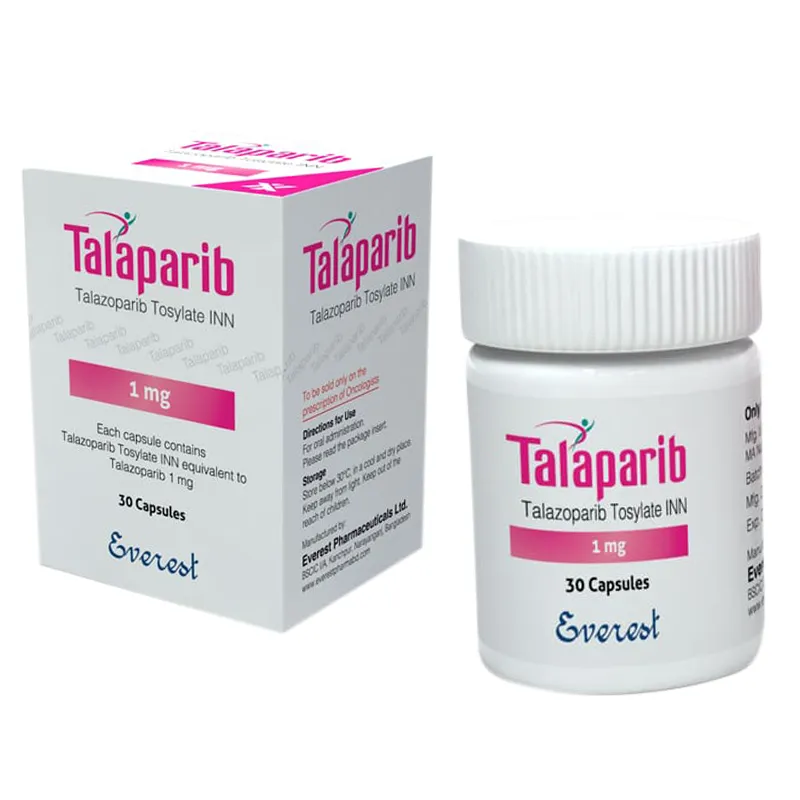
Talaparib 1 mg (Talazoparib) 30 Capsule | PARP (poly ADP-ribose polymerase) inhibitor
- Used for: Adult patients with deleterious germline BRCA-mutated (gBRCAm) HER2-negative advanced breast cancer..
- Availability: In Stock
- Shipping: Express Global Shipping (7-14 days depending on region).
- Requirement: Valid prescription from a licensed healthcare provider required.
✓ WHO GMP Certified
✓ Reviewed By Medical Expert
✓ Batch Examined in Lab
Need Patient Access Support?
Our team provides verified global sourcing assistance to help you navigate international shipping and prescription requirements safely.
Talaparib 1 mg, containing the active pharmaceutical ingredient Talazoparib, is a potent, targeted oncology medication classified as a PARP (poly ADP-ribose polymerase) inhibitor. It is the generic equivalent of the innovator brand, Talzenna. This medication is primarily utilized for adult patients with specific genetic markers—namely germline BRCA mutations—in advanced breast cancer and, in combination therapies, for certain types of advanced prostate cancer. By selectively targeting the DNA repair mechanisms within cancer cells, Talaparib aims to stall tumor growth while minimizing damage to healthy tissue. Oncologists typically utilize Talazoparib in two primary clinical settings, as established by major regulatory bodies like the FDA and EMA: Metastatic Prostate Cancer: More recently, it has been approved for use in combination with enzalutamide for the treatment of adult patients with homologous recombination repair (HRR) gene-mutated metastatic castration-resistant prostate cancer (mCRPC). The human body uses PARP enzymes to repair single-strand breaks in DNA. Talaparib works by blocking these enzymes and, perhaps more importantly, “trapping” them on the DNA strand. In cancer cells with BRCA mutations, the secondary DNA repair pathway (homologous recombination) is already faulty. When Talaparib blocks the PARP pathway, the cancer cell is left with no way to repair its DNA, leading to what we call “synthetic lethality”—the cell can no longer replicate and eventually undergoes apoptosis (cell death). Clinical research suggests that Talazoparib may be one of the most potent “PARP trappers” currently available. Dosage is highly clinical and depends on the condition being treated as well as the patient’s kidney function: Renal Adjustments: For patients with moderate renal impairment (CrCl 30–59 mL/min), the dose is often reduced to 0.75 mg daily. For severe impairment (CrCl 15–29 mL/min), it may be reduced further to 0.5 mg. The authority of Talazoparib is grounded in large-scale Phase 3 trials documented on Clinicaltrials.gov: Based on reporting from the FDA and Medscape, Talazoparib has a well-defined safety profile that requires routine clinical monitoring: Commonly Observed Effects: Serious Clinical Risks: Embryo-Fetal Toxicity: Talaparib can cause fetal harm. Effective contraception is required for both men and women during treatment and for a period after the last dose. Talaparib 1 mg capsules do not require 2°C to 8°C cold chain refrigeration. However, environmental control is essential to maintain the molecule’s integrity. Transit Integrity: Professional pharmaceutical exporters utilize climate-controlled logistics to ensure that the medication is not subjected to extreme thermal fluctuations during international transit, as high heat can degrade the active pharmaceutical ingredient. Talaparib is manufactured by Everest Pharmaceuticals. In the field of international oncology, transparency is the cornerstone of patient trust. Everest Pharmaceuticals operates under strict WHO GMP (World Health Organization Good Manufacturing Practices) standards. This ensures that every batch is produced with the same molecular purity and clinical bioequivalence as the innovator brand, Talzenna. Regular audits and stringent quality assurance protocols guarantee that the medication performs with the expected therapeutic efficacy. Accessing specialized oncology medications across borders involves specific regulatory frameworks. Patients can access Talaparib through verified pharmaceutical exporters under “Personal Use Importation” rules. A valid prescription from a licensed oncologist is a mandatory requirement. Most national drug authorities allow for the legal importation of life-saving medicines when they are not available locally or when the generic version is more accessible. This process ensures the patient receives the necessary treatment while remaining under the formal supervision of their medical team. Yes. Talaparib contains Talazoparib, the identical active ingredient found in Talzenna. Because it is manufactured under WHO GMP standards, it is clinically bioequivalent, meaning it targets the PARP enzymes with the same potency and mechanism. If you miss a dose, skip the missed dose and take the next dose at your regularly scheduled time. Do not take two doses at the same time to catch up. If you vomit after taking a dose, do not take an extra one; just wait for the next day. Talaparib is a “targeted” therapy. It works specifically on tumors that have a defect in their DNA repair system (like a BRCA mutation). If your tumor does not have this genetic marker, the medication is unlikely to be effective. Talazoparib is a substrate for the P-glycoprotein (P-gp) transporter. Certain drugs (like some heart or antibiotic medications) can act as P-gp inhibitors and increase the concentration of Talaparib in your body. Always provide your care team with a full list of your current medications. Generally, treatment continues as long as the cancer is responding and the side effects are manageable. Your oncologist will monitor your progress through regular scans and blood tests.Understanding Talaparib 1 mg Clinical Profile
What are the clinical indications for Talaparib 1 mg?
How does Talaparib work at the molecular level?
What is the recommended dosage and administration protocol?
What does the clinical data show regarding safety and efficacy?
Side Effects and Patient Safety Management
What are the side effects and safety considerations?
Are there precautions for specific populations?
Storage Data and Environmental Stability
Manufacturer Quality and Trust
How can patients access Talaparib globally?
Frequently Asked Questions (FAQs)
Is Talaparib 1 mg the same as Talzenna?
What happens if I miss a dose?
Why do I need a BRCA test before starting?
Can I take Talaparib with other medications?
How long will I need to stay on this treatment?