Prescription required. We facilitate access to medicines already prescribed by your treating physician. We do not provide medical advice or diagnoses.


Biomarker Testing in Lung Cancer: How Your Results Decide Treatment

Medically reviewed by Dr. Salma Mamdouh Elreedy, Clinical Oncologist, Sphinx Cure Oncology Center. Last reviewed: [SEPTEMBER-2026]
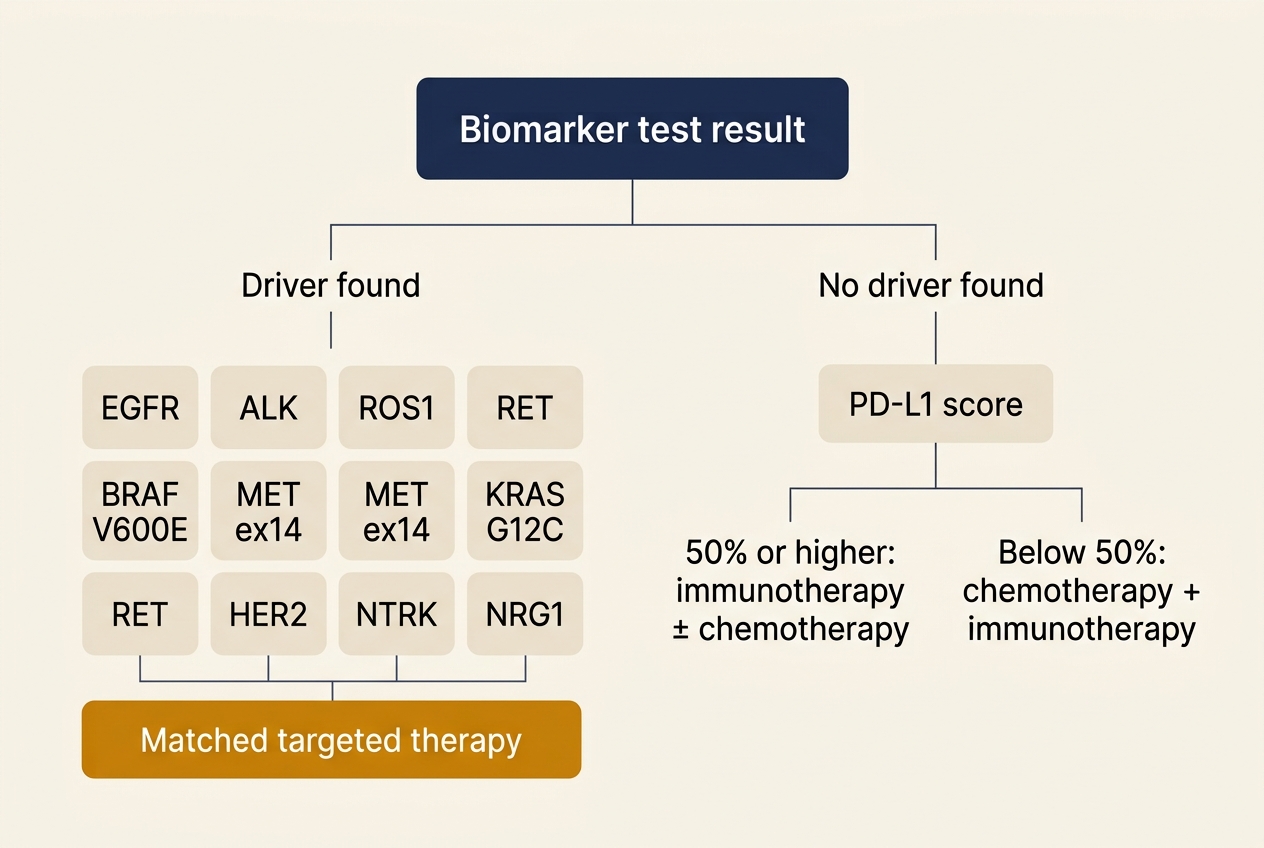
Lung cancer biomarker testing checks a sample of the tumor, or sometimes blood, for gene changes and proteins that drive the cancer. In non-small cell lung cancer (NSCLC), the results decide the first treatment. A driver change such as EGFR, ALK, or ROS1 points to a targeted tablet. If no driver is found, the PD-L1 result guides immunotherapy, with or without chemotherapy. Guidelines recommend testing before treatment starts.
Key facts
- The 2026 NCCN guideline lists 12 gene changes to test for in advanced NSCLC.
- More than 60% of lung adenocarcinomas carry a change that can be targeted.
- Full tissue panel results usually take 2 to 4 weeks.
- Fewer than half of patients worldwide receive molecular testing.
What is biomarker testing for lung cancer?
A biomarker is a measurable feature of a tumor that tells doctors how the cancer is likely to behave and which drugs are likely to work against it. In lung cancer, the biomarkers that matter most fall into two groups.
- Driver alterations. These are changes in a tumor’s DNA that switch on growth signals. The NCCN patient guideline describes them as “abnormal genes that boost cancer growth.” Examples include EGFR mutations, ALK and ROS1 fusions (also called rearrangements), and KRAS G12C mutations. Many have a matching targeted drug.
- Protein markers. These are proteins measured on tumor cells. The main one is PD-L1, which helps predict how well immunotherapy will work. HER2 and c-MET protein levels can also guide certain drugs.
You may see biomarker testing called molecular testing, genomic profiling, tumor mutation testing, or lung cancer genetic testing. Most of these changes arise in the tumor itself during a person’s life. They are not inherited and are not passed on to children. That is different from inherited (germline) genetic testing, which looks at the genes a person was born with.
Testing applies mainly to non-small cell lung cancer, which makes up about 85% of lung cancers and includes adenocarcinoma, squamous cell carcinoma, and large cell carcinoma. Small cell lung cancer is treated differently, and routine driver testing is not standard for it.
Who should get tested, and when?
Advanced or metastatic NSCLC
Guidelines recommend broad molecular profiling for everyone with advanced non-squamous NSCLC (adenocarcinoma, large cell, or NSCLC not otherwise specified). Testing is also advised for squamous cell carcinoma in some situations: people who never smoked or smoked lightly, small biopsy samples, and tumors with mixed histology. PD-L1 testing is recommended for all patients with advanced NSCLC.
Earlier-stage NSCLC (stages I to III)
Biomarker results now matter before and after surgery too. EGFR and ALK status determine whether a patient is a candidate for targeted treatment after surgery (osimertinib for EGFR-mutant disease, alectinib for ALK-positive disease). EGFR status also decides whether osimertinib follows chemoradiation in unresectable stage III disease. PD-L1 results guide immunotherapy given around surgery. Ask for EGFR, ALK, and PD-L1 results before the treatment plan is finalized.
When the cancer progresses
Tumors on targeted therapy often develop new changes that let them escape the drug. Retesting at progression, on tissue or blood, can reveal the resistance mechanism. For example, the EGFR T790M mutation appears in many patients whose cancer progresses on afatinib, gefitinib, or erlotinib, and it responds to osimertinib.
Wait for results before starting immunotherapy. Immunotherapy works poorly in EGFR-mutant and ALK-positive lung cancer. Giving a checkpoint inhibitor first and then switching to osimertinib has been linked to higher rates of serious lung inflammation (pneumonitis). If the cancer is advancing quickly, the oncologist may start chemotherapy alone while the results are pending.
Types of biomarker tests
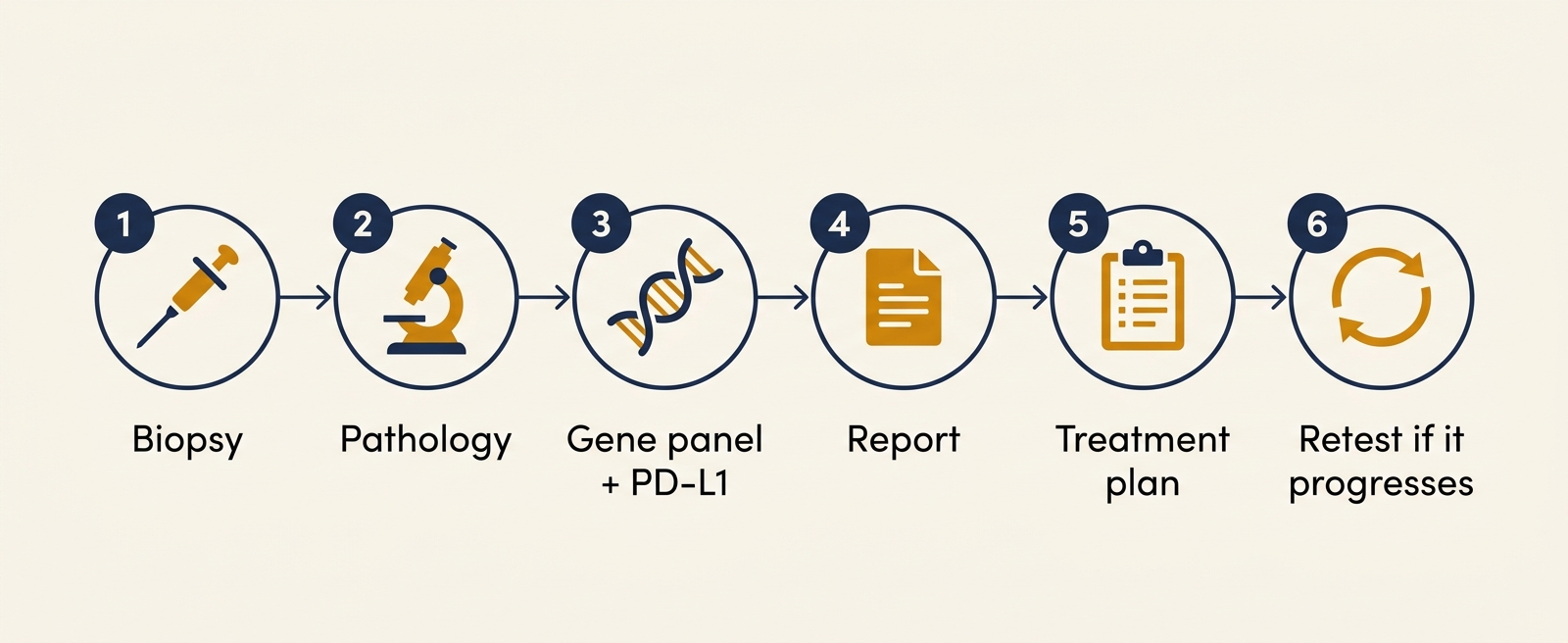
The process usually runs in six steps:
- Biopsy. Tissue is taken by bronchoscopy, EBUS needle sampling, CT-guided needle biopsy, surgery, or from fluid around the lung.
- Pathology. A pathologist confirms NSCLC and its subtype.
- Testing. The sample goes for a gene panel (ideally next-generation sequencing, or NGS) and PD-L1 staining.
- Report. The lab lists each change found, its significance, and the PD-L1 score.
- Treatment plan. The oncologist matches the result to a targeted drug or to immunotherapy and chemotherapy.
- Retesting. If the cancer progresses, a repeat tissue or blood test looks for resistance changes.
| Test | What it finds | Typical turnaround | Best use |
|---|---|---|---|
| Tissue NGS panel (DNA + RNA) | Mutations, fusions, and other changes in dozens to hundreds of genes in one run | About 2 to 4 weeks | Standard at diagnosis for advanced disease |
| Liquid biopsy (circulating tumor DNA in blood) | Most of the same changes, if the tumor sheds enough DNA into the blood | Often about 1 to 2 weeks | When tissue is scarce, when speed matters, or to check resistance at progression |
| Real-time PCR | Specific known EGFR mutations only | A few days | Widely used where NGS is unavailable; can miss EGFR exon 20 insertions and does not detect fusions |
| IHC (antibody staining) | Proteins: PD-L1, ALK (D5F3 antibody), ROS1 screening, HER2, c-MET | 1 to 3 days | PD-L1 for everyone; fast ALK screening |
| FISH | Gene rearrangements (ALK, ROS1) and amplifications | Several days | Confirming fusions when NGS is not available |
Tissue or blood: which is better?
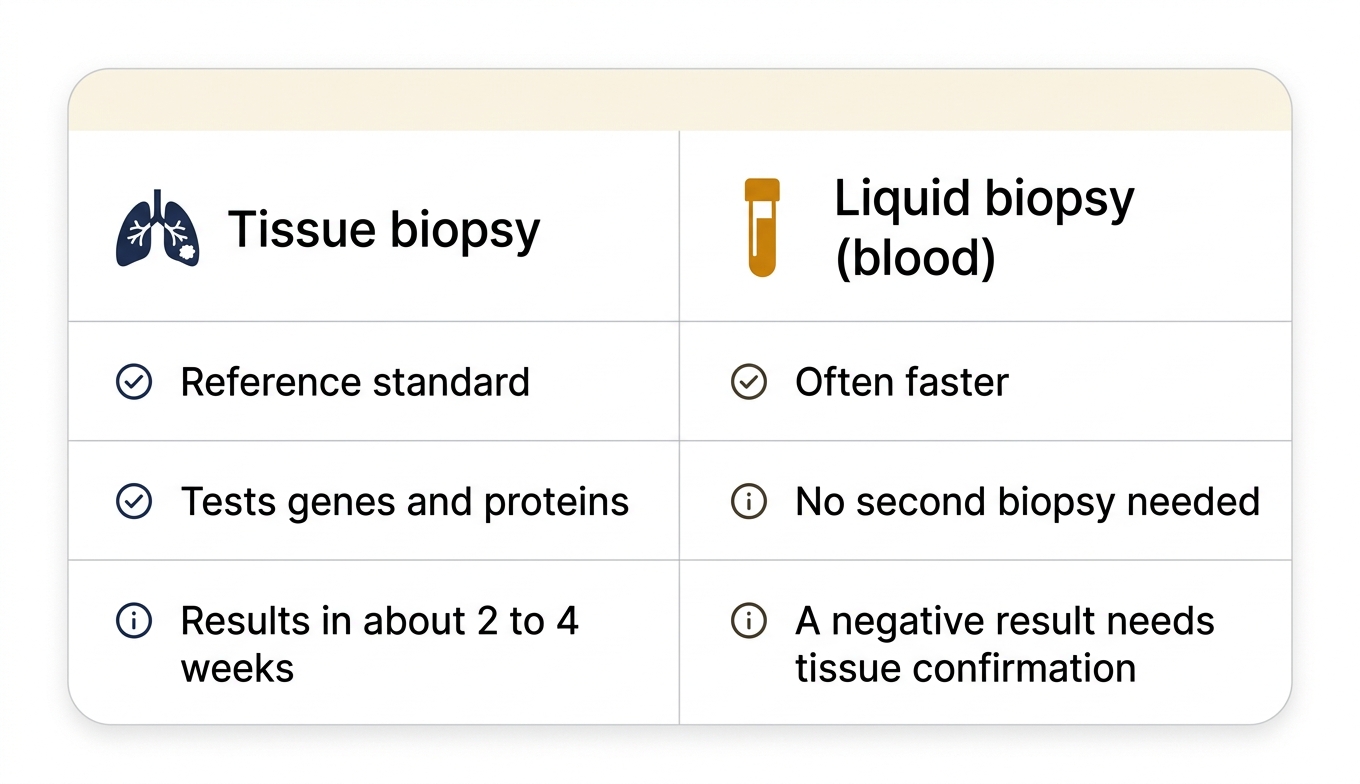
Tissue remains the reference standard because it confirms the diagnosis and supports both gene and protein testing. Liquid biopsy is useful and often faster, and guidelines accept it alongside tissue. There is one important limit: not every tumor releases enough DNA into the blood. A positive blood result can guide treatment, but a negative blood result does not rule out a driver. If the blood test finds nothing, tissue should still be tested.
Three questions to ask your doctor
- Before the biopsy: “Will enough tissue be taken for full biomarker testing?” Samples turn out too small for testing in roughly 5% to 25% of cases, which can mean a second biopsy.
- When ordering: “Is this a broad NGS panel, and does it detect gene fusions (RNA-based testing)?” Single-gene tests, run one after another, use up tissue and add weeks.
- After results: “May I have a full copy of the report?” You will need it for second opinions and for sourcing treatment.
Lung cancer biomarkers and their matched treatments
The table summarizes each biomarker in the current NCCN guideline, how often it occurs, and the main treatment options in the US. Frequencies are approximate and vary by population. Your oncologist chooses treatment based on your full clinical picture.
| Biomarker | How common (approx.) | Main first-line options | Later-line options |
|---|---|---|---|
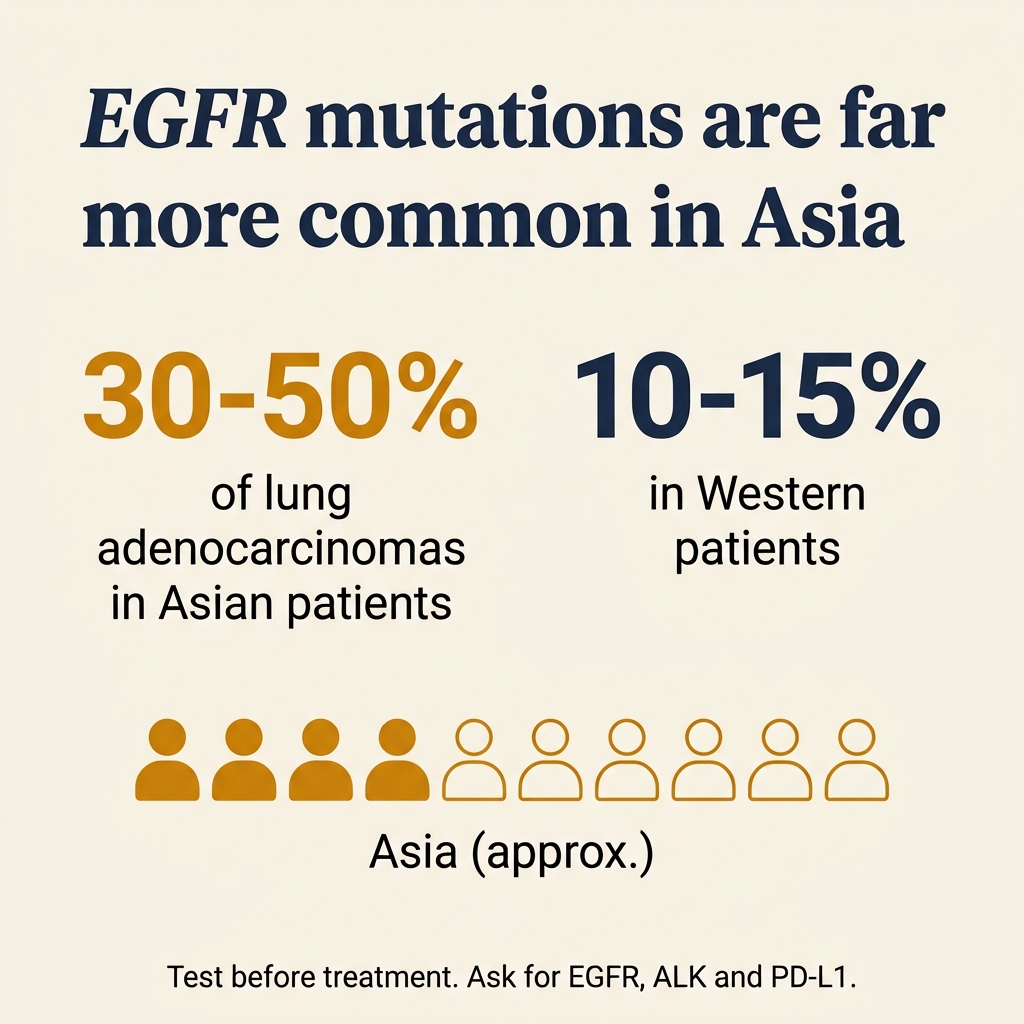
| EGFR exon 19 deletion or L858R | About 10–15% in Western patients; about 30–50% of adenocarcinomas in Asian patients | Osimertinib, alone or with chemotherapy; amivantamab + lazertinib; afatinib, dacomitinib, erlotinib, gefitinib | Datopotamab deruxtecan; amivantamab + chemotherapy |
| EGFR uncommon (G719X, L861Q, S768I) | A small share of EGFR cases | Afatinib or osimertinib | Chemotherapy-based options |
| EGFR exon 20 insertion | About 2% | Amivantamab + carboplatin + pemetrexed | Sunvozertinib (after platinum chemotherapy) |
| ALK fusion | About 5% | Alectinib, brigatinib, lorlatinib, ensartinib | Lorlatinib after earlier ALK inhibitors |
| ROS1 fusion | 1–2% | Crizotinib, entrectinib, repotrectinib, taletrectinib | Repotrectinib, taletrectinib, lorlatinib |
| BRAF V600E | 1–2% | Dabrafenib + trametinib; encorafenib + binimetinib | Chemotherapy and immunotherapy |
| KRAS G12C | About 13% in Western patients; lower in Asian patients | Immunotherapy with or without chemotherapy | Sotorasib, adagrasib |
| MET exon 14 skipping | 3–4% | Capmatinib, tepotinib | Crizotinib in certain circumstances |
| RET fusion | 1–2% | Selpercatinib, pralsetinib | Chemotherapy-based options |
| NTRK 1/2/3 fusion | Under 1% | Larotrectinib, entrectinib, repotrectinib | Chemotherapy-based options; clinical trials |
| HER2 (ERBB2) mutation | 2–4% | Zongertinib; sevabertinib | Trastuzumab deruxtecan |
| NRG1 fusion | Under 1% | Chemotherapy-based options | Zenocutuzumab |
| PD-L1 (no driver found) | Scored in every patient | 50% or higher: immunotherapy alone or with chemotherapy. 1–49% or below 1%: chemotherapy plus immunotherapy | Chemotherapy; clinical trials |
The sections below explain each biomarker in more detail and link to our product guides where a WHO-GMP certified generic is available through named-patient access.
EGFR-mutant lung cancer
EGFR is the most common targetable driver in lung cancer. It is far more frequent in Asian patients, women, and people who never smoked. The two “classic” mutations, exon 19 deletions and L858R, account for about 85% to 90% of EGFR cases and respond well to EGFR tyrosine kinase inhibitors (TKIs).
Osimertinib, a third-generation TKI, is the most widely used first-line option. In the MARIPOSA trial, amivantamab plus lazertinib improved overall survival compared with osimertinib alone (hazard ratio 0.75; 56% vs 44% of patients alive at 3.5 years). Lazertinib’s US approval is in combination with amivantamab. Second-generation afatinib remains an option, and it carries specific FDA labeling for the uncommon mutations G719X, L861Q, and S768I.
The exact mutation matters. In the LUX-Lung 3 and 6 trials, afatinib’s overall-survival benefit over chemotherapy was seen in patients with exon 19 deletions, but not in those with L858R. Exon 20 insertions behave differently and generally do not respond to standard EGFR TKIs.
Related guides: Osimert 80 mg (osimertinib) · Lazerib 80 mg (lazertinib) · [Anib 40 mg (afatinib)]([PLACEHOLDER: Anib 40 mg URL])
ALK-positive lung cancer
ALK fusions occur in about 5% of NSCLC and tend to affect younger patients who have never smoked. Brain metastases are common, so drugs that reach the brain matter. Alectinib, brigatinib, and lorlatinib all show strong activity in the brain. In the ALEX trial, alectinib outperformed crizotinib in delaying progression, including in the brain. Alectinib is also approved after surgery for resected ALK-positive disease (ALINA trial). Crizotinib, the first ALK inhibitor, is still an option, though newer agents are preferred first-line.
Related guides: Alecnib 150 mg (alectinib) · Lorbrexen 100 mg (lorlatinib) · Alkixen 250 mg (crizotinib)
ROS1-positive lung cancer
ROS1 fusions (1–2%) share features with ALK and respond to several of the same drugs. Crizotinib was the first approved ROS1 treatment. Newer options (entrectinib, repotrectinib, and taletrectinib, approved in June 2025) have better brain activity. Repotrectinib and taletrectinib also work against the common G2032R resistance mutation.
Related guide: Alkixen 250 mg (crizotinib)
RET fusion-positive lung cancer
RET fusions (1–2%) are treated with selective RET inhibitors. Selpercatinib is approved for RET fusion-positive NSCLC and for other RET-altered solid tumors, and it has activity in the brain.
Related guide: [Selpacta 80 mg (selpercatinib)]([PLACEHOLDER: Selpacta 80 mg URL])
KRAS G12C
KRAS is the most common driver in Western patients and is linked to smoking. The G12C subtype (about 13%) has two approved inhibitors, sotorasib and adagrasib, used after first-line treatment. First-line treatment is currently immunotherapy-based. Newer KRAS G12C drugs such as divarasib are in late-stage trials.
Read more: KRAS G12C mutations in advanced NSCLC
BRAF V600E
BRAF V600E (1–2%) is treated with a combination of a BRAF inhibitor and a MEK inhibitor: dabrafenib plus trametinib, or encorafenib plus binimetinib. Other BRAF mutations (non-V600E) do not respond the same way.
Read more: BRAF mutation and targeted cancer therapy
MET, HER2, NTRK, and NRG1
MET exon 14 skipping (3–4%) is more common in older patients and responds to capmatinib or tepotinib. It is different from c-MET protein overexpression, which is measured by IHC and can qualify previously treated patients for telisotuzumab vedotin.
HER2 (ERBB2) mutations (2–4%) gained two first-line oral options in 2026: zongertinib (February) and sevabertinib (September). Trastuzumab deruxtecan is used after earlier treatment.
NTRK and NRG1 fusions are rare (under 1% each) but important to find. They are best detected with RNA-based testing, and each has a targeted drug.
PD-L1 and immunotherapy
PD-L1 is reported as a tumor proportion score (TPS): the percentage of tumor cells that show the protein. The NCCN patient guideline calls 50% or more “high” and 1% to 49% “low.” When no driver alteration is found, PD-L1 helps choose between immunotherapy alone and immunotherapy combined with chemotherapy. Pembrolizumab and nivolumab are among the checkpoint inhibitors used in lung cancer.
Related guides: Pemrest (pembrolizumab) · Nivorest (nivolumab)
How to read your biomarker report
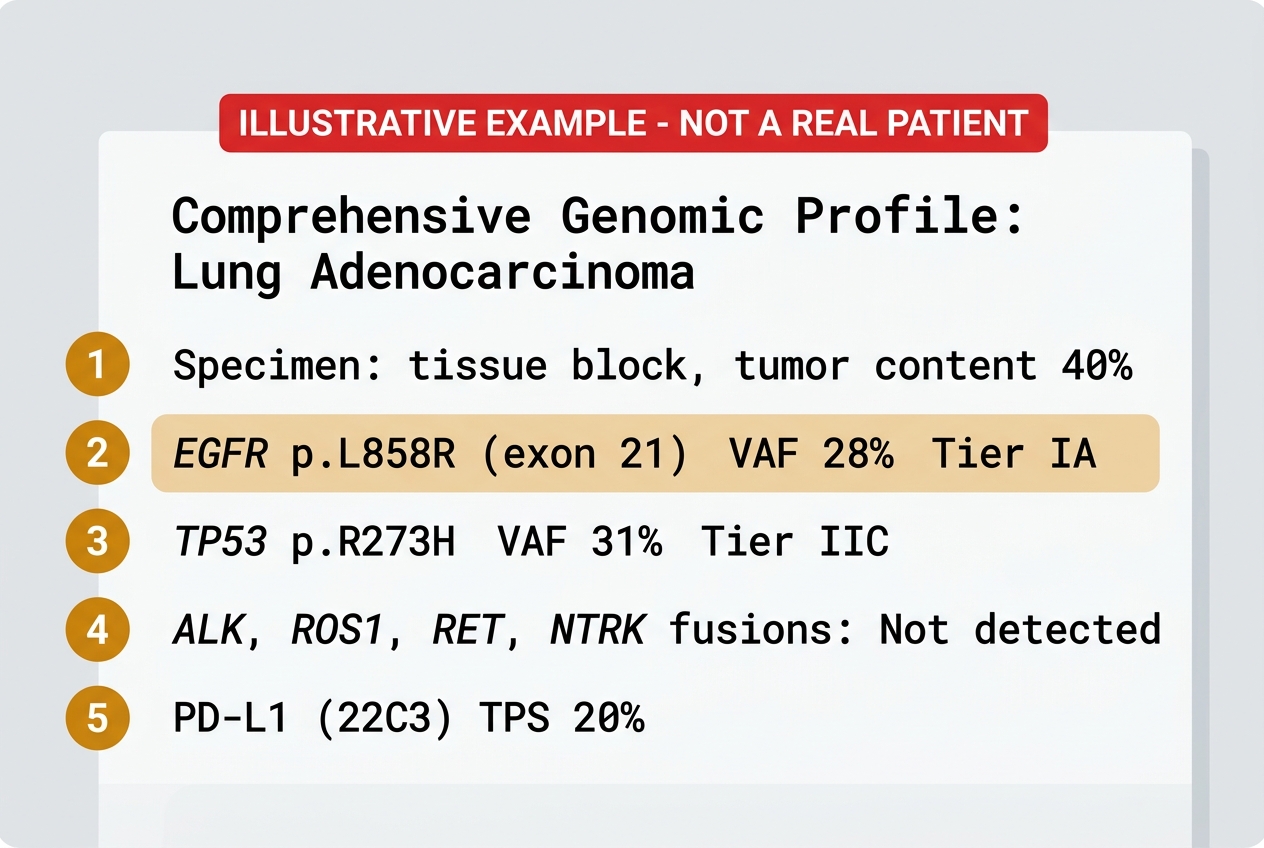
Lab reports differ in layout, but most contain the same parts. The example below is illustrative only and does not belong to a real patient.
| Report line (illustrative example) | What it means |
|---|---|
| Specimen: FFPE tissue block, tumor content 40% | How much of the sample was cancer. Low tumor content (often under 20%) can cause false negatives. |
| EGFR p.L858R (exon 21), VAF 28%, Tier IA | The actionable finding. “p.L858R” means the protein has arginine (R) instead of leucine (L) at position 858. VAF (variant allele frequency) is the percentage of DNA reads carrying the change. Tier I findings have an approved, matched therapy. |
| TP53 p.R273H, VAF 31%, Tier IIC | A common change that usually has no matched drug. Such changes may be listed as Tier II or III, or as a “variant of uncertain significance.” |
| ALK, ROS1, RET, NTRK fusions: Not detected | “Not detected” only covers the genes on the panel. Check whether fusions were assessed by RNA. |
| PD-L1 (22C3), TPS 20% | The PD-L1 score and the antibody used (22C3 or SP263). In a patient with an EGFR mutation, a targeted drug takes priority over the PD-L1 score. |
Other terms you may see: “QNS” (quantity not sufficient) means the sample was too small to test. “Rearrangement” and “fusion” mean the same thing for ALK and ROS1. “Exon 19 deletion” may appear as “p.E746_A750del.” “TMB” (tumor mutational burden) counts total mutations and has a limited role in lung cancer decisions.
What if no driver mutation is found?
About half of patients with advanced NSCLC have no targetable driver, and more than half of squamous cancers do not. Treatment is then guided by PD-L1 and tumor type:
- PD-L1 50% or higher: immunotherapy alone, or immunotherapy with chemotherapy.
- PD-L1 1% to 49%, or below 1%: chemotherapy combined with immunotherapy is usually preferred.
Before accepting a “no driver” result, confirm that the panel was broad and tested for fusions by RNA. Fusions such as ALK, ROS1, RET, NTRK, and NRG1 can be missed by DNA-only panels. If only a small panel or single-gene tests were done, ask whether broader testing, on tissue or blood, is possible.
Biomarker testing when you live outside the US or Europe
Access to testing varies widely. A review of testing in emerging markets reported that fewer than half of patients received molecular testing across 102 countries, and that patients paid for 38% of tests themselves. In many regions, the only test offered is EGFR by PCR, sometimes with ALK by IHC.
This matters most where EGFR is common. EGFR mutations are found in a much larger share of lung adenocarcinomas in Asian patients than in patients of European ancestry, so a missed or incomplete test affects many people.
- Partial panels still help. An EGFR PCR plus ALK IHC covers the two most common targets. If both are negative, ask about a broader NGS panel next.
- Samples can travel. Tissue blocks or unstained slides can often be sent to a reference laboratory in another city or country. Ask your pathology department how to release them.
- Blood testing avoids a second biopsy. Several international labs accept liquid biopsy samples shipped from abroad, which is useful when tissue has run out.
- Keep every report. A clear copy of the biomarker report and prescription is required for named-patient access to treatment.
New lung cancer treatments approved in 2025 and 2026
Biomarker-guided treatment is changing quickly. These US FDA decisions shape current practice:
| Date | Drug | Biomarker | What changed |
|---|---|---|---|
| Sep 2026 | Sevabertinib (Hyrnuo) | HER2 mutation | Approval extended to untreated patients; 75% response rate in 69 patients |
| Feb 2026 | Zongertinib (Hernexeos) | HER2 mutation | First-line accelerated approval; 77% response rate in 74 patients |
| Aug 2025 | Zongertinib (Hernexeos) | HER2 mutation | First approval, for previously treated patients |
| Jul 2025 | Sunvozertinib (Zegfrovy) | EGFR exon 20 insertion | Accelerated approval after platinum chemotherapy |
| Jun 2025 | Datopotamab deruxtecan (Datroway) | EGFR mutation | For patients previously treated with an EGFR TKI and chemotherapy |
| Jun 2025 | Taletrectinib (Ibtrozi) | ROS1 fusion | 85% to 90% response rates in patients new to ROS1 drugs |
| May 2025 | Telisotuzumab vedotin (Emrelis) | c-MET protein overexpression | For previously treated non-squamous NSCLC |
Newer drugs are often unavailable or slow to arrive outside the US. Your oncologist can advise which options are realistic where you live.
From biomarker result to treatment access
Generic Oncology supports patients and physicians in accessing WHO-GMP certified generic oncology medicines under Named Patient Program (NPP) frameworks. Once your biomarker result and your oncologist’s prescription are in hand, our team can confirm which matched options can be sourced and explain the documentation your country requires.
Important: WHO-GMP certification applies to the manufacturing facility. FDA approval dates and trial results on this page refer to the originator (brand-name) medicines. They are not FDA approval of any generic product. Treatment decisions belong to your treating oncologist.
Have your biomarker report? Send your report and prescription, and we will confirm which WHO-GMP certified options are available for your result.
- [Upload prescription]([PLACEHOLDER: Upload Prescription page URL])
- WhatsApp: +880 1792 288474
- Email: [email protected]
Frequently asked questions
Does every lung cancer patient need biomarker testing?
Everyone with advanced non-squamous NSCLC should have broad biomarker testing, and everyone with advanced NSCLC should have PD-L1 testing. Testing is also advised for squamous cancers in people who never or lightly smoked, and for EGFR, ALK, and PD-L1 in earlier-stage disease when treatment around surgery is planned.
How long do biomarker test results take?
A full tissue NGS panel usually takes about two to four weeks. PD-L1 and ALK staining often take a few days. Liquid biopsy results frequently return faster than tissue results.
Can treatment start before the results come back?
Guidelines advise waiting for EGFR and ALK results before starting immunotherapy, because immunotherapy works poorly in these cancers and can raise side-effect risks with later targeted drugs. If the cancer is advancing quickly, an oncologist may start chemotherapy alone while waiting.
Is a blood test (liquid biopsy) as good as a tissue biopsy?
A positive liquid biopsy result is reliable enough to guide treatment. A negative result does not rule out a driver, because some tumors shed little DNA into the blood. Tissue testing should follow a negative blood test.
What does PD-L1 50% mean?
It means at least half of the tumor cells show the PD-L1 protein. The NCCN patient guideline calls this “high” PD-L1. When no driver mutation is present, a high score supports immunotherapy alone or with chemotherapy.
What does “no actionable mutation detected” mean?
It means none of the genes on that panel showed a change with a matched targeted drug. Check that the panel was broad and included RNA fusion testing. If it was, treatment is usually guided by PD-L1 and tumor type.
Do I need to be tested again if my cancer grows?
Often, yes. Cancers on targeted therapy can develop resistance changes, such as EGFR T790M after first- or second-generation EGFR drugs. A repeat tissue or blood test can show which treatment is likely to work next.
Are EGFR mutations more common in Asian patients?
Yes. EGFR mutations are found in a much larger share of lung adenocarcinomas in Asian patients than in patients of European ancestry. They are also more frequent in women and in people who never smoked.
This page is for educational purposes and does not replace advice from your treating oncologist. Treatment options, approvals, and availability vary by country and change over time. FDA approvals referenced here apply to originator medicines.
References
- NCCN Guidelines for Patients: Metastatic Non-Small Cell Lung Cancer, 2026
- NCCN Clinical Practice Guidelines: Non-Small Cell Lung Cancer, Version 4.2026. JNCCN 2026;24(4)
- Testing for EGFR mutations and ALK rearrangements in advanced NSCLC: considerations for countries in emerging markets
- FDA: accelerated approval of sevabertinib (September 2026)
- FDA: accelerated approval of datopotamab deruxtecan for EGFR-mutated NSCLC
- MARIPOSA final overall survival: amivantamab plus lazertinib vs osimertinib
- FDA approves taletrectinib in ROS1-positive NSCLC
- First-line accelerated approval of zongertinib for HER2-mutant NSCLC
- 2025 FDA lung cancer approvals
- Non-small cell lung cancer in 2026: a narrative review of clinical advances and systemic challenges